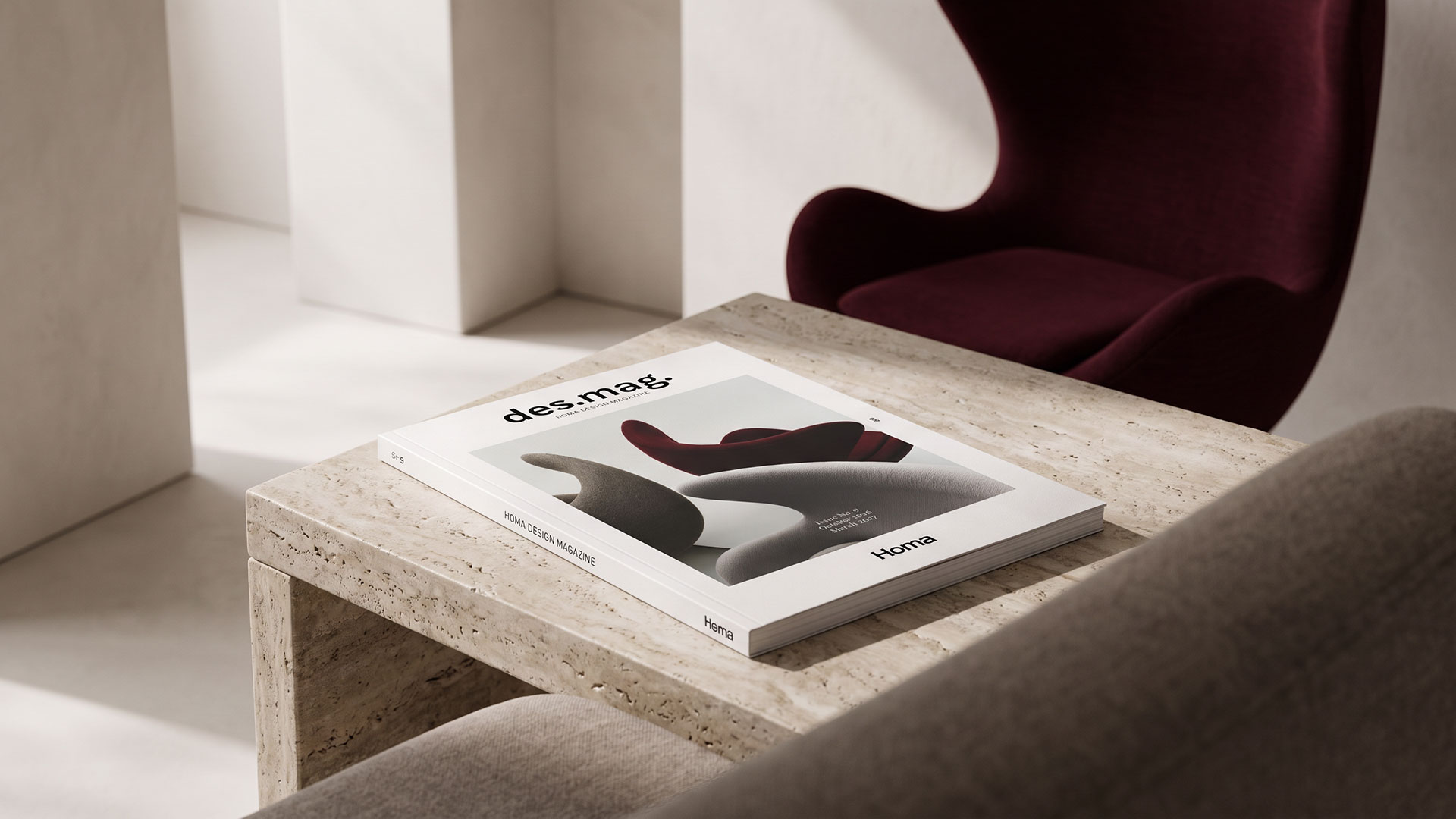
Homa Design Magazine Issue 9 — on meaning, memory and why some things deserve to remain.
By Federico Rebaudo, General Manager, Homa Europe
We manufacture objects. Millions of them!
That fact alone makes a question increasingly important:
What makes some objects disappear into everyday life, while others remain with us, acquire meaning and sometimes even become part of culture?
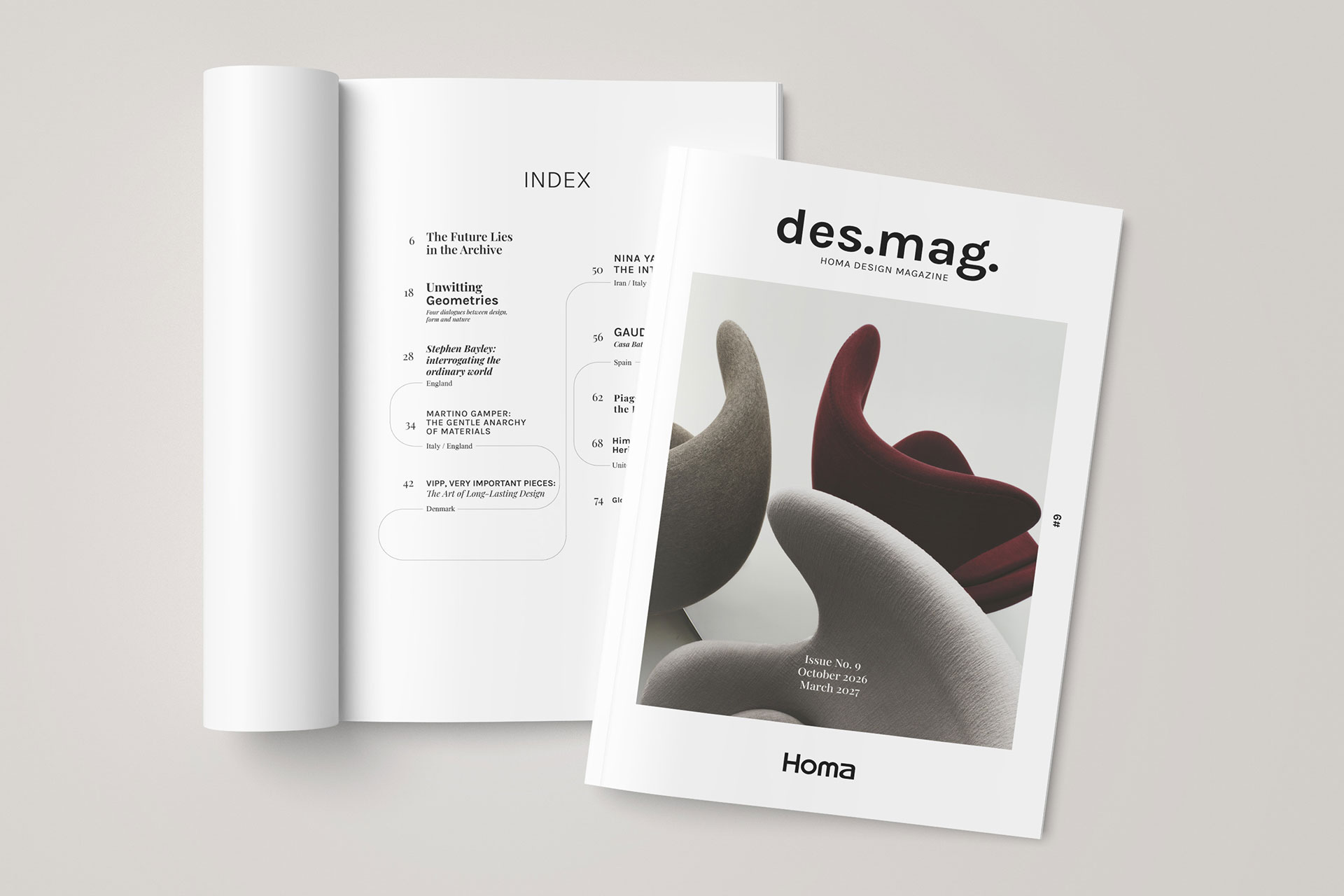
On 15 October 2026, opening day of the 140th Canton Fair, Homa will release Issue No. 9 of Homa Design Magazine.
The date is familiar territory for us. Canton Fair has always been a place where products, technologies and industrial capabilities become visible. But Design Magazine was created to look slightly further: beyond what an object does, towards what it means, how people relate to it, and why certain ideas remain relevant long after the moment in which they were created.
This ninth edition comes at a particularly meaningful point in that journey.
Earlier this year, Homa Design Magazine received the iF DESIGN AWARD 2026, an international recognition that meant a great deal to everyone involved in the project. Not simply because an editorial project created by an OEM manufacturer had received one of the world’s most established design honours, but because the recognition confirmed something we have believed from the beginning:
Industrial culture can be created not only through products, but also through ideas.
Read about Homa Design Magazine winning the iF DESIGN AWARD 2026
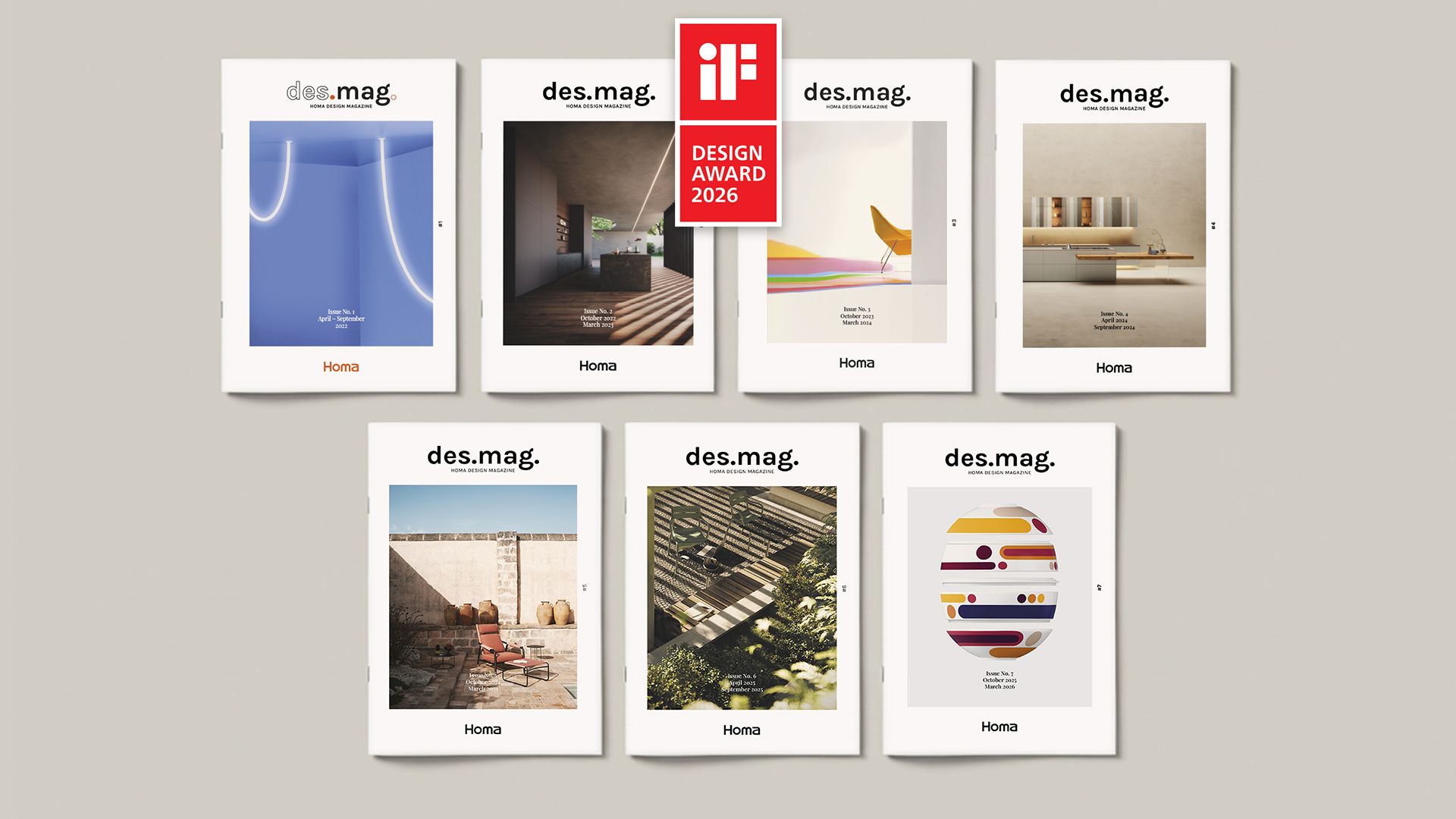
When we launched the first Homa Design Magazine, the ambition was quite simple.
We wanted to create a space where an industrial company could remain curious.
Not a catalogue disguised as editorial content. Not another place to describe refrigerators. Instead, an opportunity to look at architecture, furniture, food, materials, behaviours and changing lifestyles — because all of them eventually influence the products people choose to bring into their homes.
That approach later became part of our broader Design Manifesto: design is not a final cosmetic layer applied to industrial capability. It begins with understanding people, behaviours, environments and meaning.
Explore the Homa Design Manifesto
By Issue 6, I wrote that we had set out to create a tool and had somehow created a reference point. Designers, architects, buyers and trend observers were reading and sharing it beyond the immediate Homa community. That was when it became clear that tangential content could do something conventional B2B communication often struggles to achieve: create relevance before asking for attention.
Design Magazine 6: More Than a Magazine
Issue 9 continues that trajectory, but asks an even more fundamental question.
What happens between people and things over time?
The issue begins by looking backwards. Not nostalgically, but strategically!
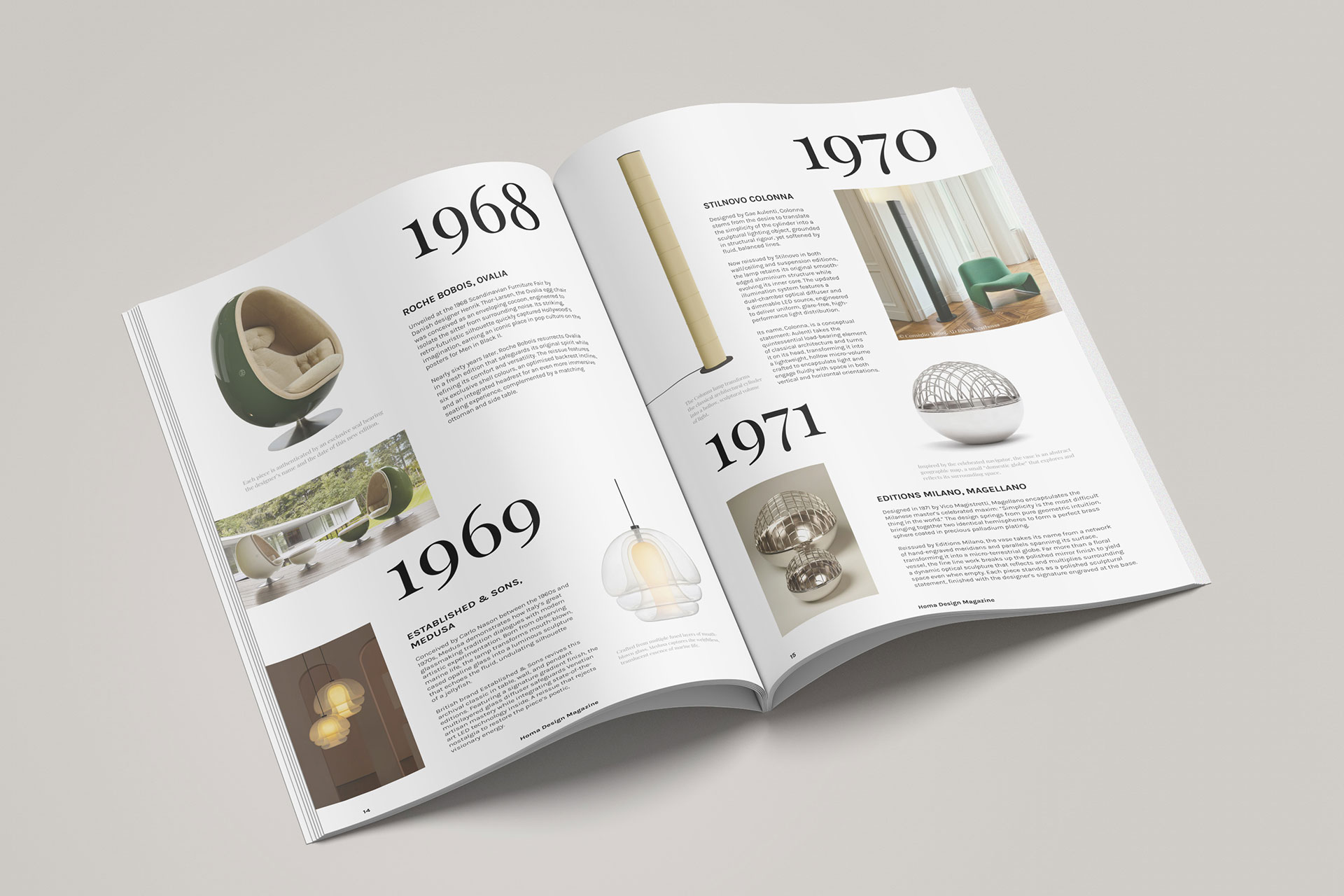
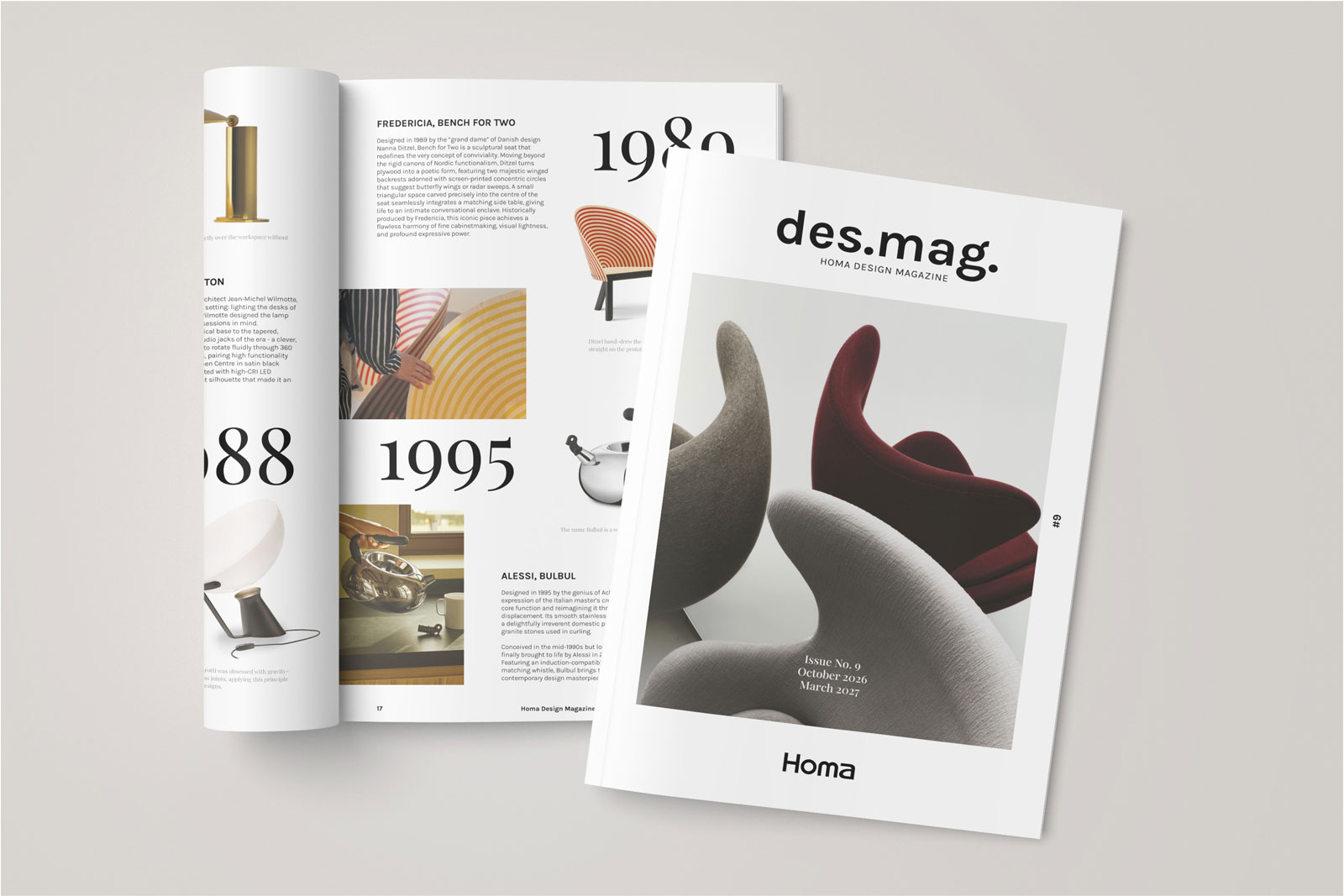
The Future Lies in the Archive explores the remarkable resurgence of design re-editions: objects conceived decades ago, returned to contemporary life through new materials, cleaner manufacturing processes and updated technologies.
The underlying idea is fascinating.
For much of the twentieth century, design asked:
What new form can we invent?
Perhaps the twenty-first century increasingly asks:
What value can we add to the forms we have inherited?
The magazine presents a chronology of objects stretching from Bernard-Albin Gras’ 1921 lamp and Eileen Gray’s E1027 table to pieces by Frank Lloyd Wright, Gerrit Rietveld, Gio Ponti, Arne Jacobsen, Verner Panton and many others. The argument is not that the past was better. It is that timelessness itself can represent innovation when everything around us is accelerating towards obsolescence.
There is an interesting connection here with another conversation Homa is opening at this Canton Fair through our new white paper, The New Shape of Differentiation.
When markets become saturated with newness, novelty alone loses some of its differentiating power.
Meaning becomes more important.
Explore The New Shape of Differentiation
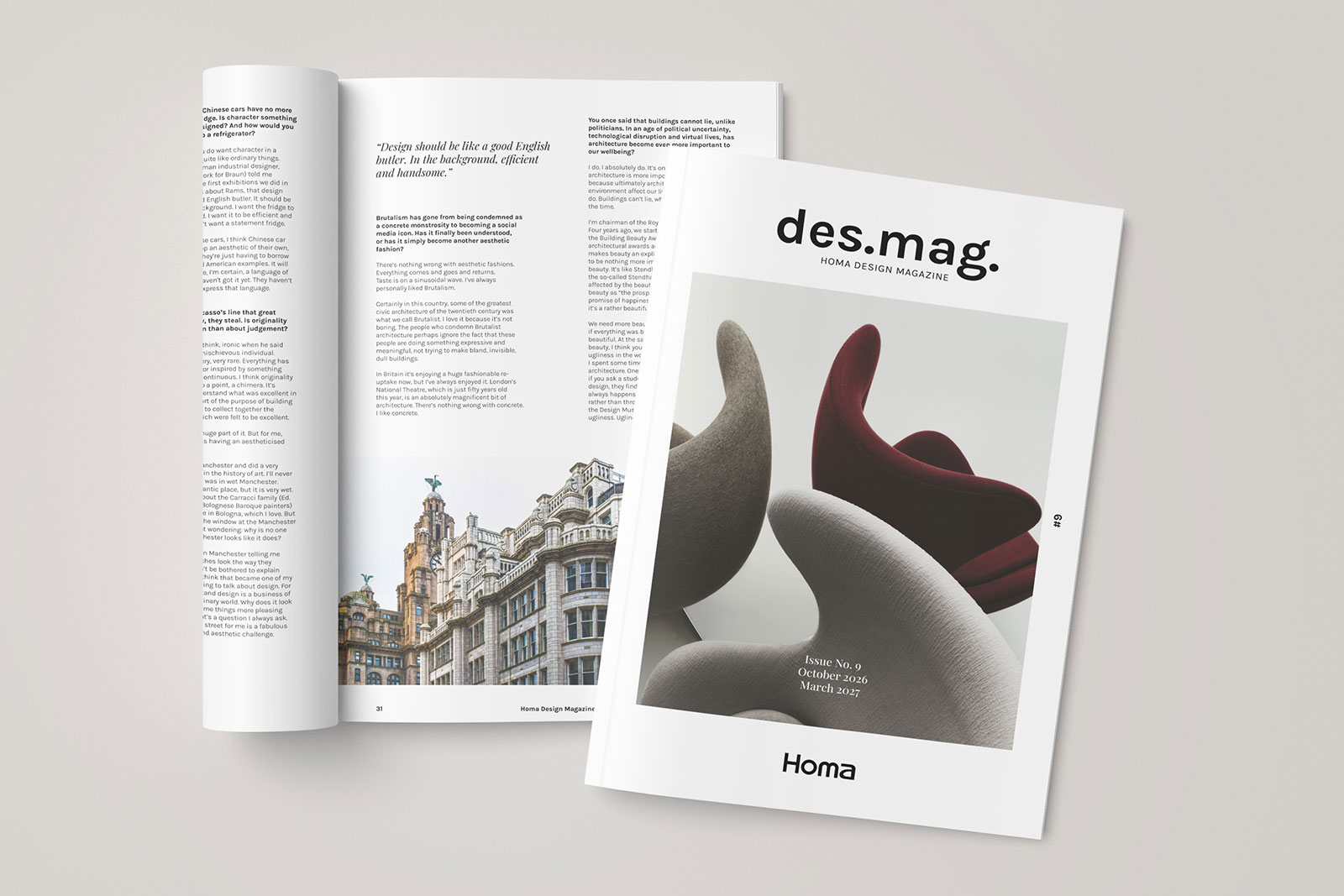
Our cover story brings us to Stephen Bayley, one of Britain’s most influential design critics and one of the personalities behind the creation of London’s Design Museum.
The conversation is deliberately provocative.
Bayley questions whether the era of “Design with a capital D” may be approaching its conclusion as more of our culture migrates towards virtual experiences. Yet at precisely the same time, he anticipates a renewed appetite for tangible, analogue things.
That tension interests me greatly.
The more invisible technology becomes, the more significant physical experience can become.
Materials. Weight. Texture. Imperfection. The way an object ages.
These are difficult qualities to reduce to specifications, but they profoundly influence the relationship people develop with things. The interview moves freely between beauty, simplicity, artificial intelligence, luxury, Brutalism and ordinary objects — which is precisely why it belongs in this magazine.
Design becomes interesting when it teaches us to notice what we had stopped noticing.
That idea continues through Martino Gamper.
His celebrated 100 Chairs in 100 Days dismantled discarded chairs and recombined them into one hundred unique objects.
Gamper does not attempt to remove history from materials. He works with it.
Scratches, previous uses, repairs and imperfections become part of the new object rather than defects that need to disappear. Reuse becomes an act of creativity rather than merely an environmental obligation.
This distinction matters. Sustainability is often discussed as reduction: less material, less energy, less waste.
Design can add another dimension: more meaning from what already exists.
It is a principle that connects naturally with our broader belief that innovation begins with understanding rather than technology.
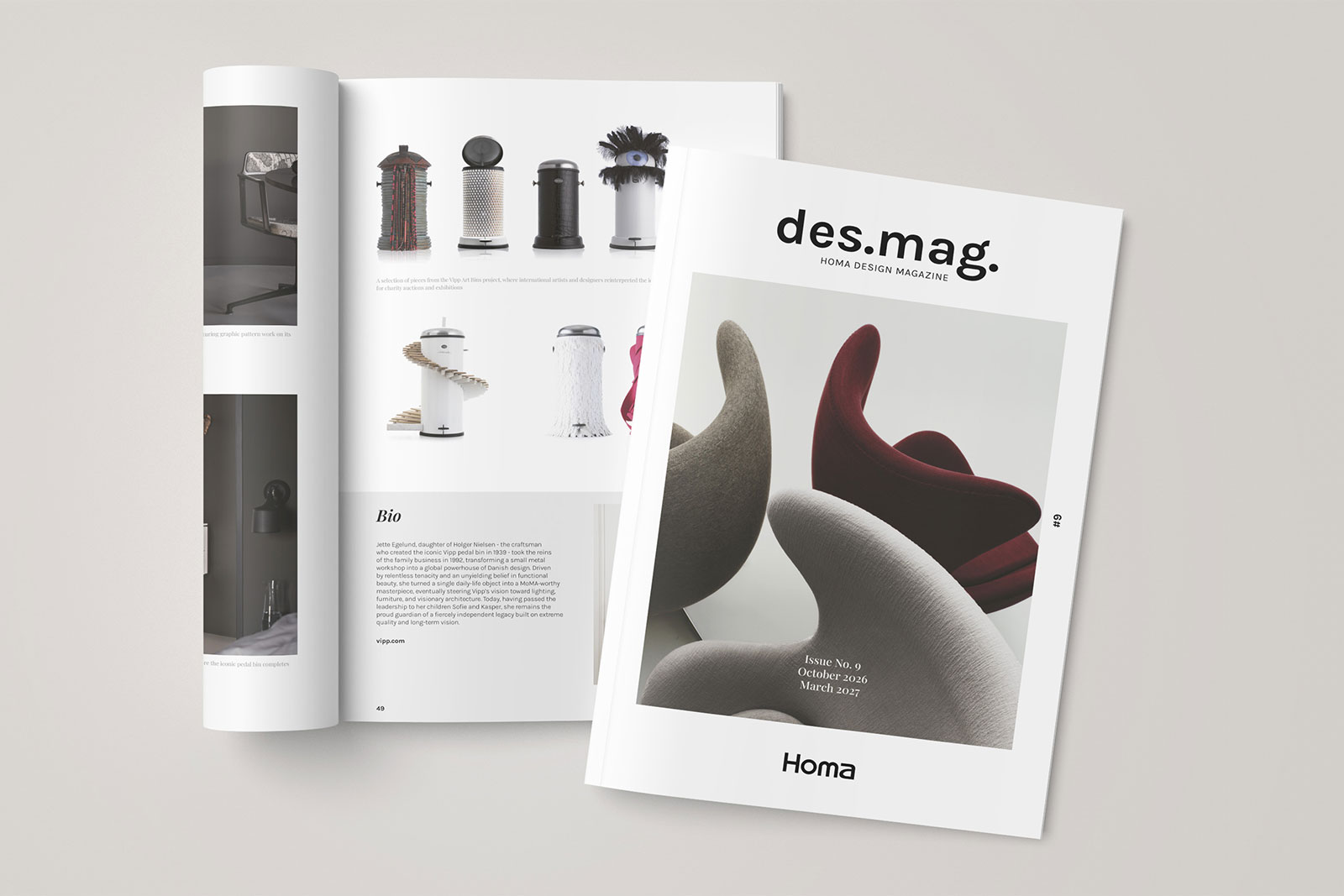
Few stories illustrate the persistence of meaning better than Vipp.
In 1939, Holger Nielsen made a pedal bin for his wife’s hair salon. There was no lifestyle strategy. No brand architecture. No ambition to create an icon. There was a problem to solve.
Almost ninety years later, that object has become the foundation of a design universe spanning kitchens, furniture, lighting, architecture and hospitality.
In our conversation with Jette Egelund, the lesson is strikingly contemporary: longevity does not begin by designing something to look timeless. It begins with function, materials, manufacturing quality and the conviction that an object deserves to continue being useful. Vipp even continues to make spare parts for products conceived decades ago.
Luxury, viewed from this perspective, changes meaning too.
Less abundance.
More intention.
Less novelty.
More permanence.
With Nina Yashar, founder of Milan’s Nilufar Gallery and Nilufar Depot, we enter another territory.
Objects become expressions of authorship, cultural history and personal identity.
Her remarkable ability to place different periods and cultures in dialogue reminds us that coherence does not require uniformity. Sometimes the most interesting environments emerge precisely because different voices are allowed to remain different.
There is something here that resonates strongly with our work as a pure OEM manufacturer.
We manufacture for many brands.
Our responsibility is not to make their products look alike.
It is to create industrial conditions in which different identities can remain recognisable.
Manufacturing creates the grammar. Design allows different voices to speak.
That is also why, in an OEM context, I continue to describe design as a matter of relevance rather than authorship.Read A Matter of Relevance
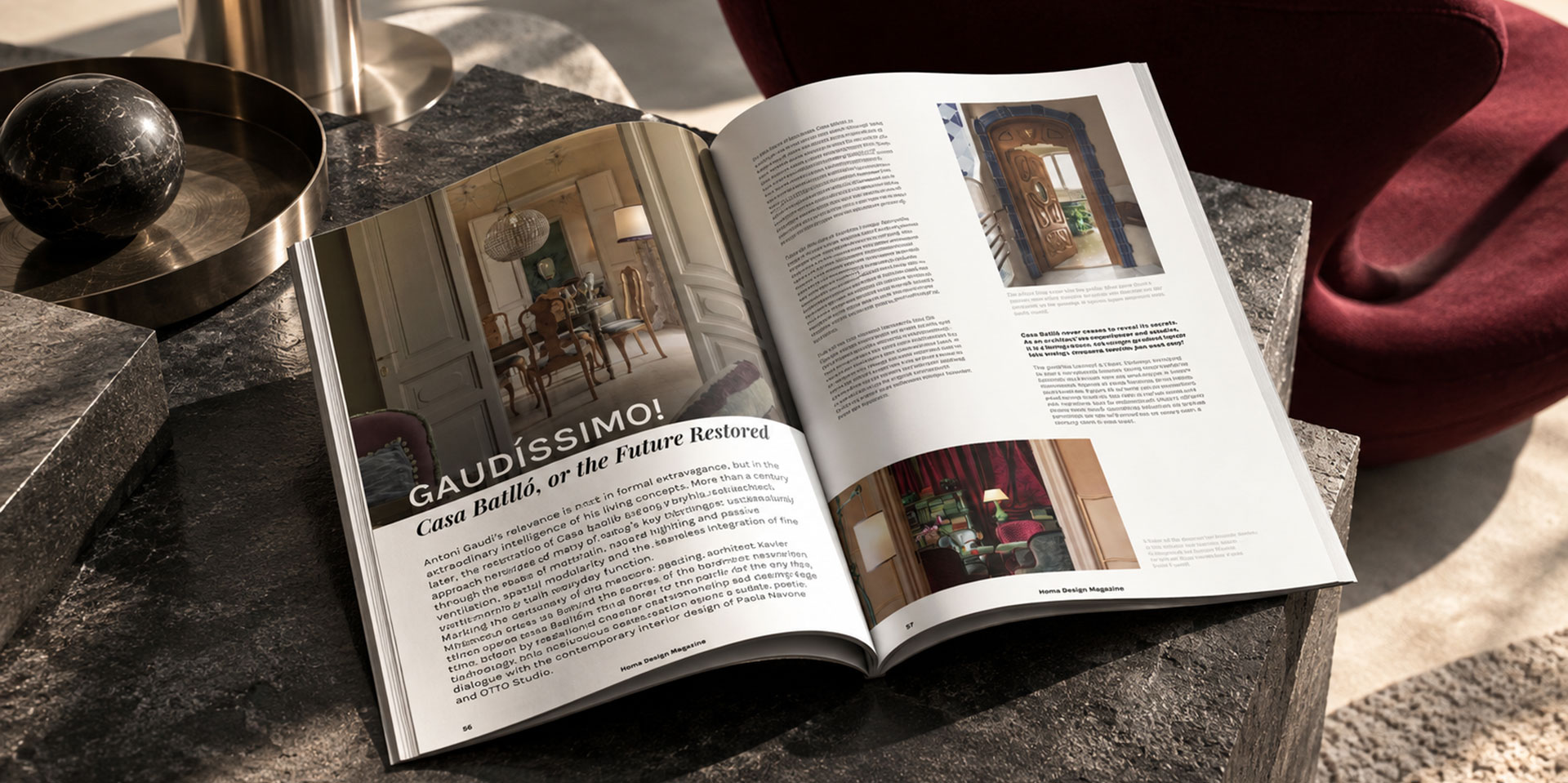
At Casa Batlló, the conversation changes scale but not principle.
Architect Xavier Villanueva takes us inside the extraordinary restoration of Gaudí’s building in Barcelona.
Here, technology is used not to overwrite the past but to understand it.
Advanced diagnostic techniques combine with traditional Catalan craftsmanship to uncover original solutions for natural light, ventilation, reuse of materials and spatial adaptability — reminding us just how contemporary some century-old thinking remains.
Paola Navone and OTTO Studio then introduce a clearly contemporary interior layer without pretending to be Gaudí. That distinction is important.
Respecting identity does not mean freezing it.
Sometimes the most intelligent design intervention is the one that understands what should change — and what should remain untouched.
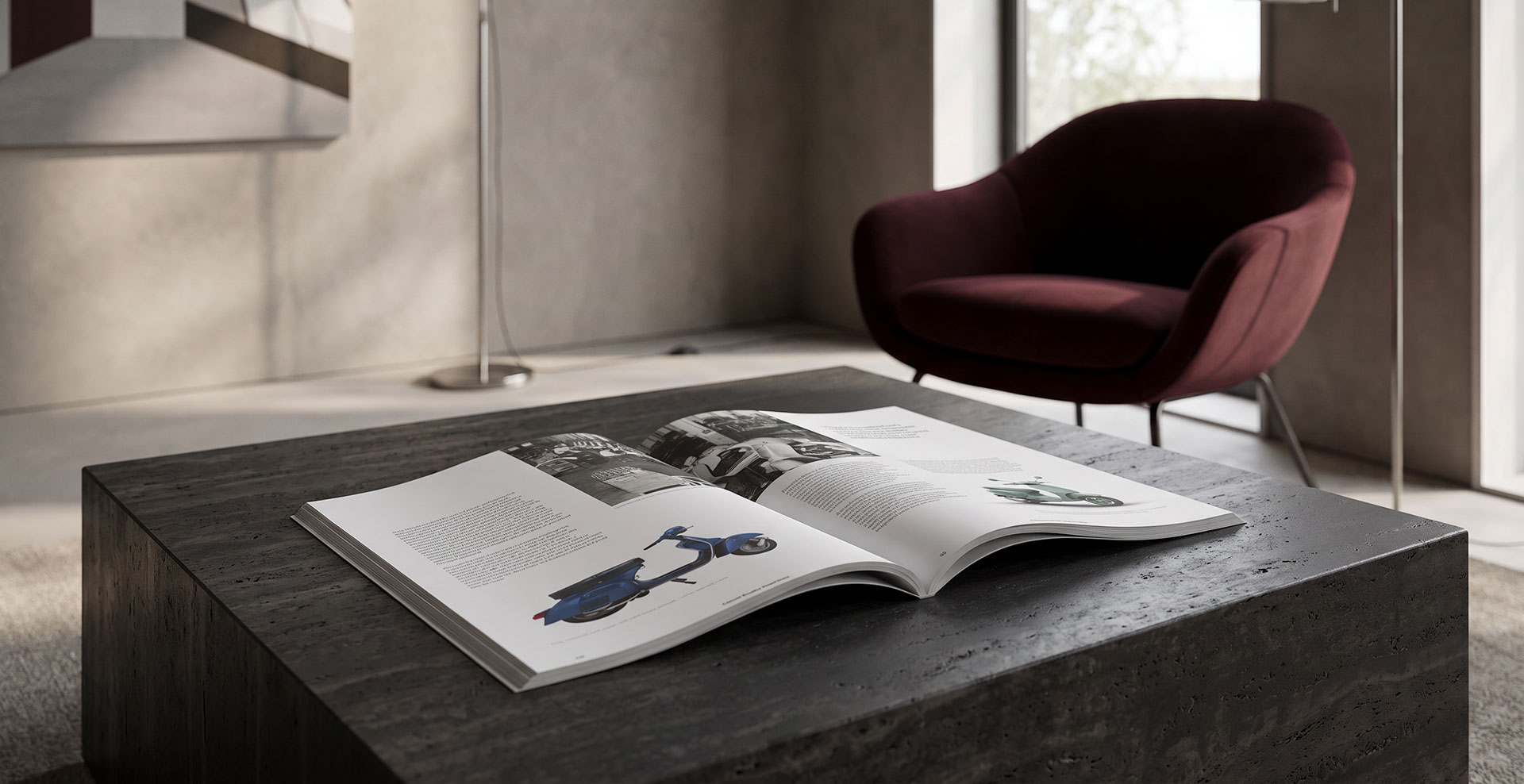
The Vespa gives us perhaps the clearest example of what happens when an industrial object escapes the boundaries of its category.
Born from post-war necessity and aeronautical engineering, it became something considerably larger through cinema, communication, social change and the way people physically experienced mobility.
Eventually, the scooter became shorthand for freedom, youth, Italy and a particular idea of life.
The engineering remained essential.
But engineering alone cannot explain why an object enters collective memory.
This is an idea we have explored repeatedly through Homa Design Magazine: successful industrial design connects capability with culture.
It is why our design discussions have ranged from Karim Rashid’s reflections on the capacity of design to influence human behaviour to conversations on materials, technology and the changing relationship between people and domestic objects.
Why Design Matters: What We Learned from Karim Rashid
The Scotsman Who Softened Technology — our conversation with Rod White
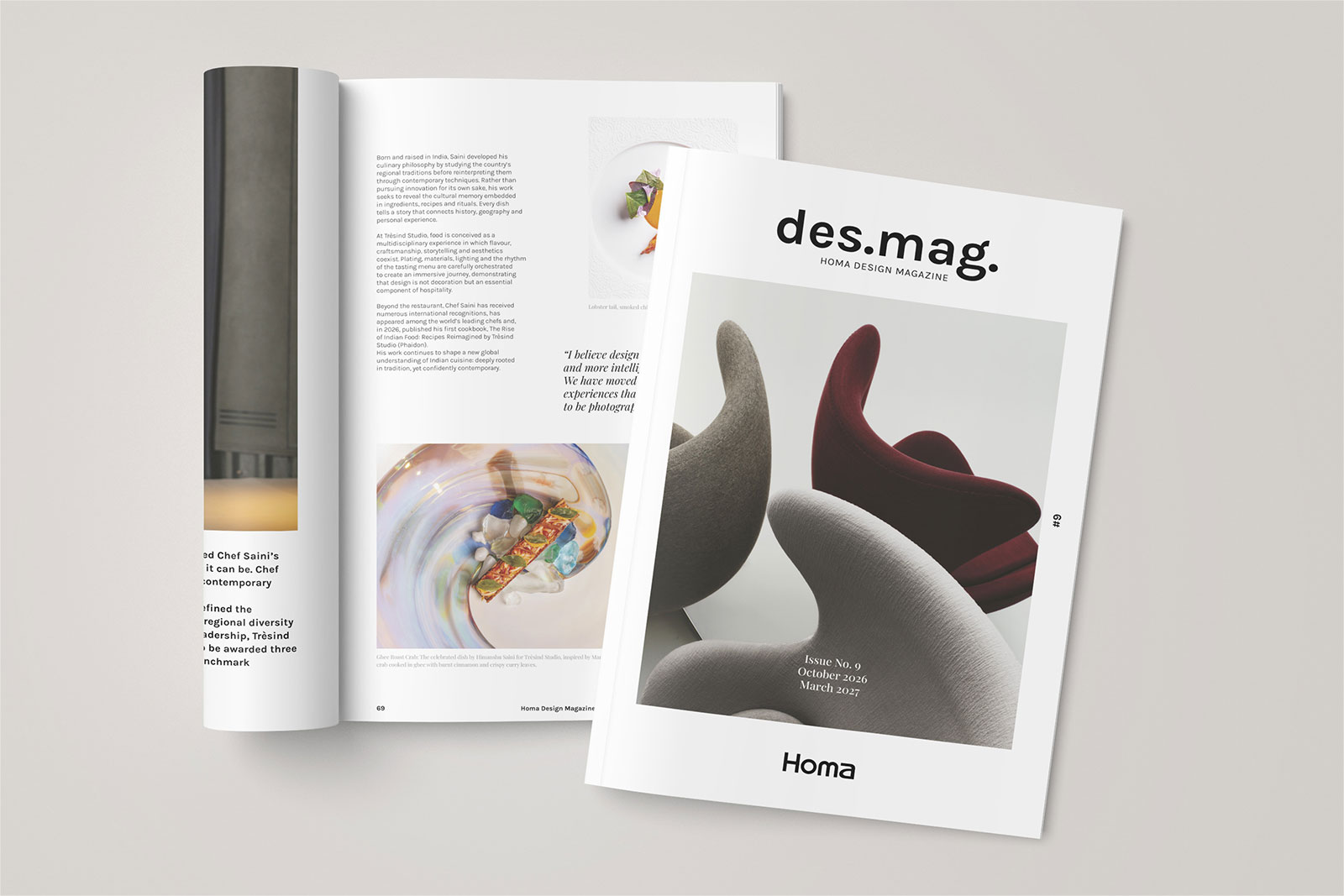
The issue concludes its journey with chef Himanshu Saini, Executive Chef of Trèsind Studio in Dubai.
His work begins with India’s extraordinary regional diversity, but rather than reproducing tradition literally, he translates memory, geography, ingredients and rituals into a contemporary language.
Here, food is only one component.
Tableware, material, light, space, plating and hospitality together create the experience.
Again, design is not decoration added afterwards.
It is how meaning becomes perceptible.
For a company whose industrial purpose is centred on preserving food, this final conversation brings us naturally back home.
Food Preservation, Care and Design have never been separate subjects for us. They are different ways of asking the same question:
How can industry contribute meaningfully to everyday life?
That thinking has accompanied Homa for years, from our early Design Manifesto and the idea of Pop Exclusivity to more recent reflections on design as relevance and on food preservation as a human benefit.
Discover Homa’s approach to accessible design and Pop Exclusivity
From Survival to Meaning — Food Preservation as a human benefit
I return often to this question because, from the outside, the answer may not be obvious.
Homa does not sell Design Magazine.
Nor do we manufacture most of the objects appearing inside it.
So why continue?
Because an industrial company learns by remaining curious about the world in which its products will live.
The kitchen does not exist independently from architecture.
A refrigerator does not exist independently from furniture.
Technology does not exist independently from behaviour.
Food preservation does not exist independently from culture.
And design cannot exist independently from people.
When we launched the magazine, we described design as one of Homa’s three fundamental pillars alongside Care and Food Preservation.
Explore the origins of Homa Design Magazine and its three editorial pillars
Since then the project has grown from an editorial experiment into an internationally recognised platform for design culture — culminating this year in the iF DESIGN AWARD.
Homa Design Magazine — iF DESIGN AWARD 2026
But the award is not the destination.
If anything, it increases the responsibility to remain curious.
To keep asking questions.
To bring voices from outside our immediate industry into the conversation.
And then to allow those ideas to travel back into the way we understand products, people and markets.
Technology tells us what can be made.
Design helps us understand what deserves to be made — and why it might matter.
That is the space Homa Design Magazine continues to explore.
Issue No. 9 will be released on 15 October 2026, opening day of the 140th Canton Fair in Guangzhou.
If these pages make you look slightly differently at a chair, a bin, a building, a Vespa, a meal — or perhaps even a refrigerator — then they have probably done their job.

Federico Rebaudo
General Manager, Homa Europe
Editor-in-Chief, Homa Design Magazine
Six perspectives on design, culture and the meaning of objects.
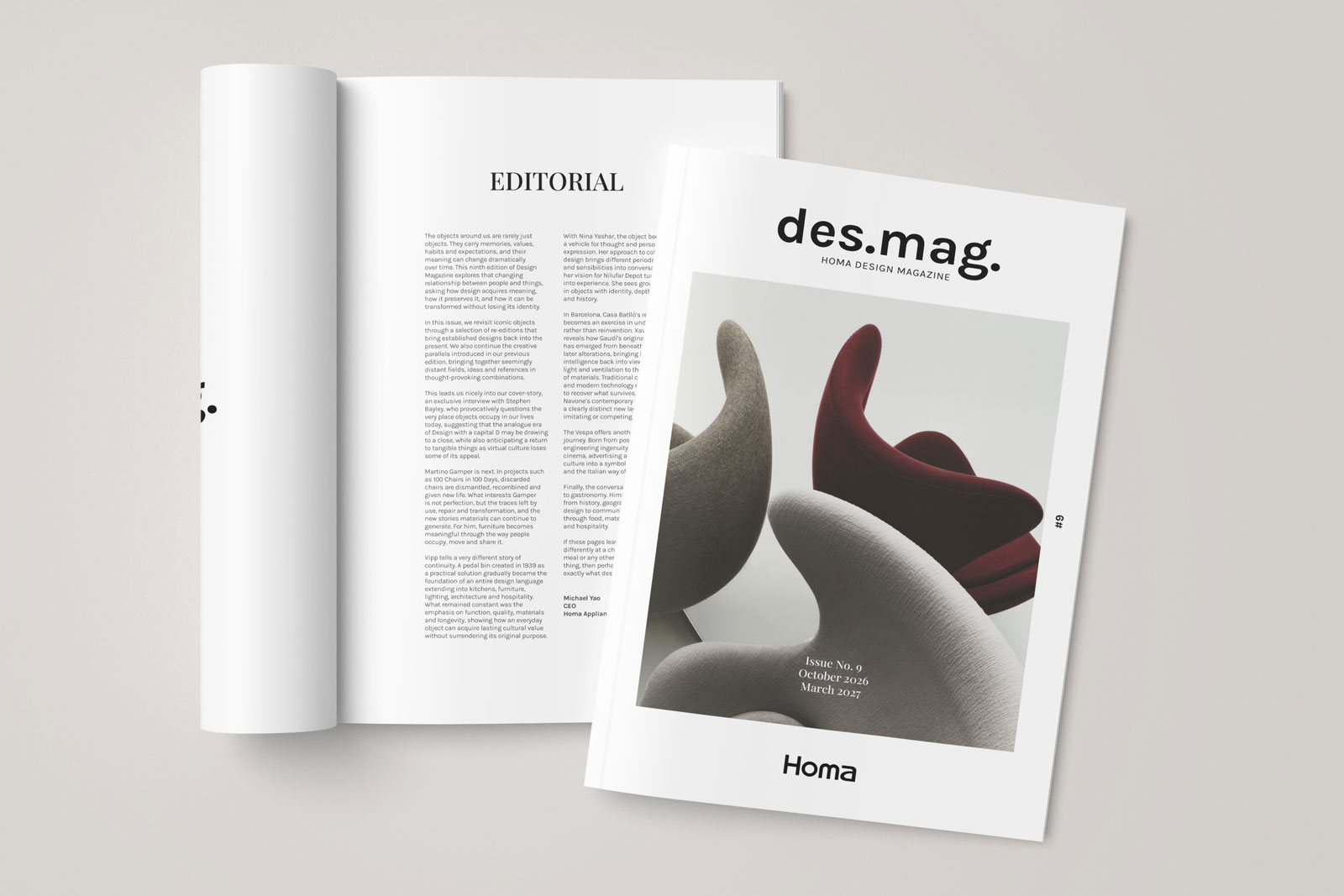
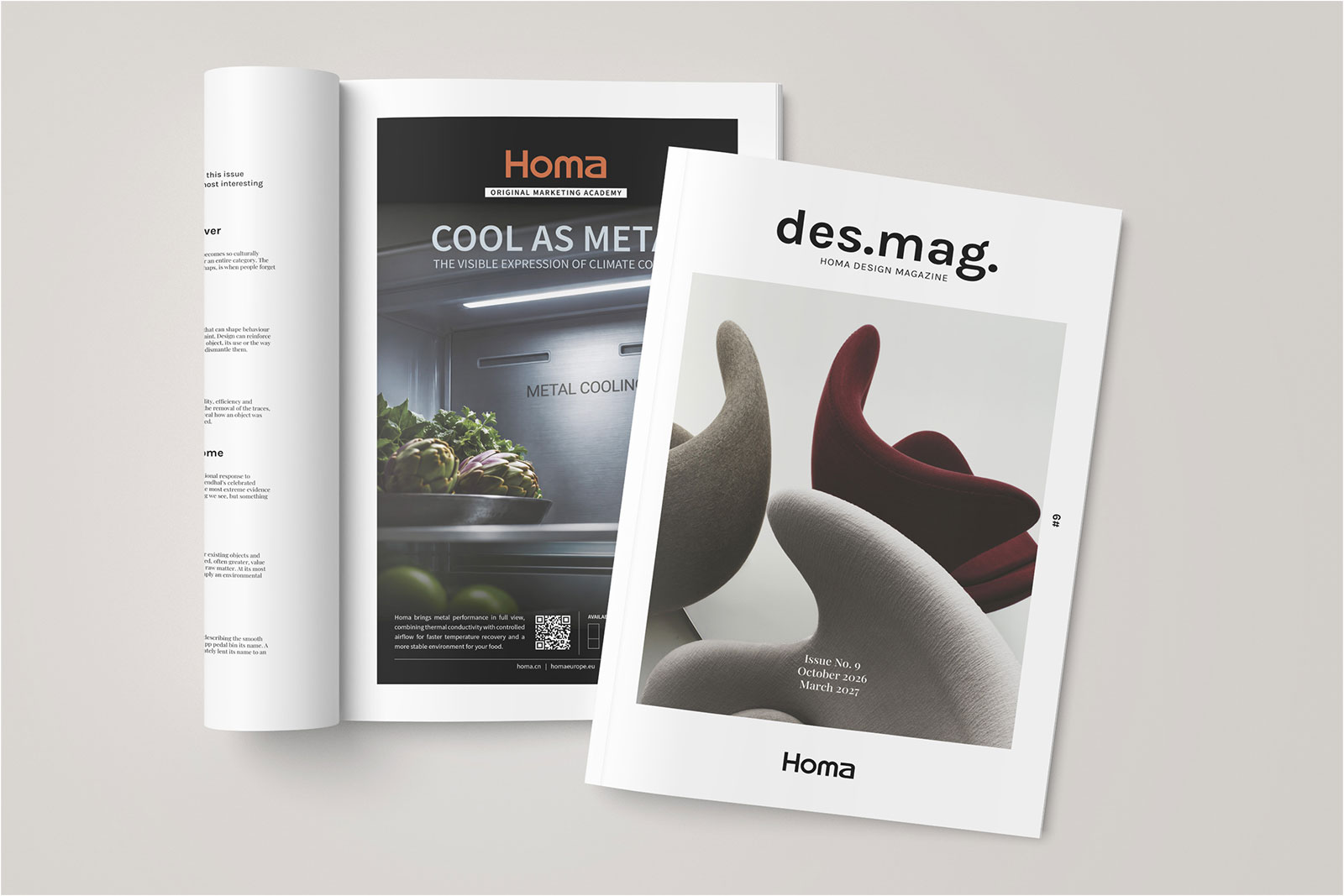
HOMA DESIGN MAGAZINE — ISSUE 9
15 OCTOBER 2026
Objects carry more than function.
They carry meaning.
Discover Issue No. 9 at Homa during the 140th Canton Fair in Guangzhou.
PRE-BOOK YOUR COPY: Ask your Homa sales representative to reserve a printed copy.
COLLECT YOUR COPY AT CANTON FAIR: 15–19 October 2026.
Homa Design Magazine is a vibrant editorial venture on a mission to ignite the flame of design thinking across the entire Homa community—encompassing Homa people, our partners, and beyond! Yet, its influence extends beyond these boundaries; it serves as a beacon of design culture poised to illuminate our entire industry.
Today, it stands as a remarkable testament to the potency of tangential marketing, presenting a novel approach to captivating audiences. The magazine is the result of a collaborative effort, with the original idea stemming from Homa Europe.
Editor in Chief: Federico Rebaudo
Project Coordination: Federico Gallina
Contributing writers: Elena Scandroglio, Pierre Ley, Patrizio Cionfoli
Coordination, Design & Layout: Studio Volpi
For further information and Press Contact: info@homaeurope.eu
Copyright HOMA 2026- Issued By Homa Marketing dept. on October 2026
For further Information and Press Contacts: info@homaeurope.eu