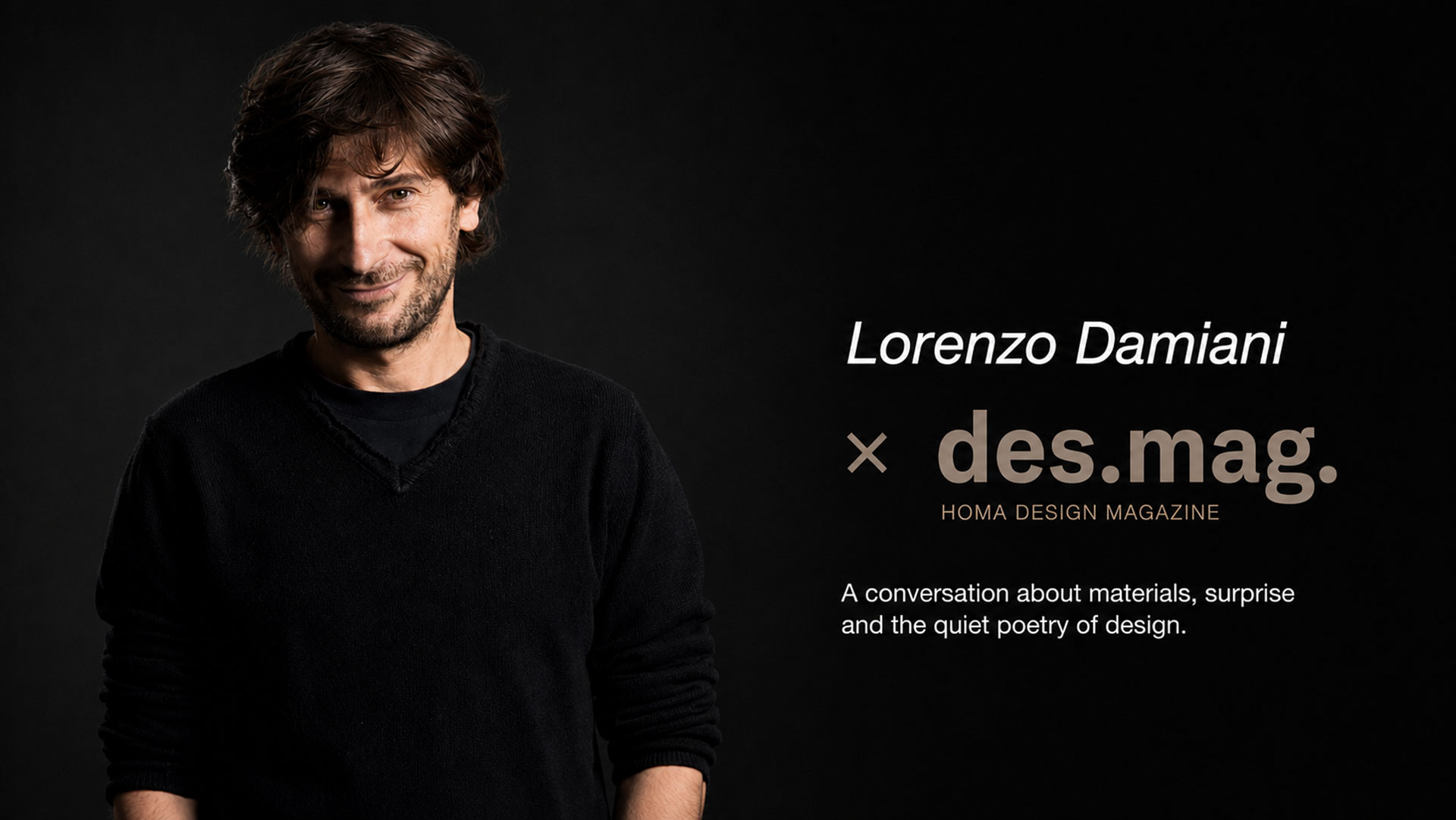
What material intelligence, surprise and care can teach industrial culture.
An Editor’s Note by Federico Rebaudo
Some conversations explain design. Others quietly change the way we look at it.
We invited Lorenzo Damiani because his work asks a question that matters deeply to industry: what genuinely deserves to be created?
This question sits at the heart of Homa’s design culture. For us, design is not an aesthetic layer added at the end of development. It is a way of deciding what matters—of turning industrial capability into relevance for people.
Damiani does not romanticise sustainability, empathy or innovation. In fact, he is suspicious of labels. Yet his practice makes their meaning tangible. A thin sheet of marble bends because the designer listens to the material at its breaking point. Chipboard acquires dignity through knowledge and care. A vase becomes useful because of the message it carries. This is not spectacle. It is material intelligence, restraint and responsibility.
At Homa, we work at industrial scale—and scale amplifies every decision. Damiani reminds us that innovation does not always begin by adding more. It can begin by seeing what others overlook: a defect as an opportunity, less material as better design, surprise as the consequence of rigorous thought. This resonates with our understanding of Care: not a soft value, but a discipline exercised towards people, resources and the generations that follow.
I have often returned to the idea that design becomes structural when it changes how an organisation thinks and decides. Damiani’s perspective gives this conviction a physical form. When a technical limitation becomes an intelligent solution, design is no longer decoration. It becomes culture translated into action.
His reflections on artificial intelligence are equally precise. AI can be valuable in experienced hands, but superficial use risks making ideas increasingly similar. I do not read this as a rejection of technology. I read it as a demand for judgement. Technology can expand what we are able to make; it cannot decide why something should exist or whom it should serve.
Perhaps his discomfort with the expression ‘empathetic design’ is the most revealing point of all. For Damiani, placing people at the centre should be self-evident. This is a useful challenge for every company. If empathy must continually be declared, perhaps it has not yet become culture. When it does, it shapes decisions before it becomes communication.
So, why Damiani on des.mag.? Because his work connects poetry with production, wonder with precision and responsibility with form. Rainbow Without a Storm is not an artificial image of nature; it is the creation of the exact conditions in which nature can reveal itself. That is also a powerful metaphor for design—and for industry. We cannot manufacture meaning. We can create the conditions for meaning to emerge.
des.mag. exists to bring into our industry voices that help us ask better questions. Damiani leaves us with an essential conviction: good design is not measured by how loudly it announces innovation, but by how precisely it transforms limits into value, materials into meaning and responsibility into something people can experience.

RAINBOW WITHOUT A STORM
A conversation with Italian designer Lorenzo Damiani about the design of surprise, the poetry of form, folding marble and other wonders.
What happens when marble bends, chipboard acquires dignity and rainbows appear without a storm? In the mind—and hands—of Lorenzo Damiani, design moves beyond noise and novelty to become a quiet act of intelligence. With an inventor’s curiosity and a craftsman’s sense of responsibility, Damiani transforms familiar materials into unexpected forms, always guided by a deeper purpose. Poetic yet precise, his work reminds us that true innovation often lies in restraint—and that good design is not only what lasts, but also what speaks.
In this conversation, Lorenzo Damiani shares his perspective on design, its functions and its responsibilities.
What does regenerative design mean to you, and how important is it today?
I believe it is essential to consider the impact of every design decision. We live within a constantly evolving system that is also shaped—and regenerated—by what we do. We must therefore always consider the consequences of our actions. Personally, I prefer the expression ‘common-sense design’ to ‘regenerative design’. In a world already overflowing with the superfluous, perhaps the most responsible choice is to minimise new production or, at the very least, to act with extreme care. The world is ours, but it will also belong to those who come after us.
What insights and possibilities have emerged from your research into materials at the limits of their performance—their ‘breaking point’?
I would answer with the example of my work with marble. I began using thin-sawn marble in 2007, but it was only in 2012 that I was fortunate enough to realise that this semi-finished stone could be used in a different way. Until then, thin slabs had always been used flat. I simply transformed a technical limitation into a design opportunity, learning how to exploit the flexibility created by their reduced thickness to produce marble objects that, before this research, could only have been made by milling a solid block. The real objective was always to save material. The experience gained through my ‘bent marble’ projects eventually led to the extreme case of ‘foldable marble’ in the Foglio bench, where a thin marble slab flexes beneath the weight of the person sitting on it. Reaching that result required extensive research to determine marble’s exact breaking point—even though the project does not rule out the possibility that the material might eventually break after repeated use.
You have said that ‘communicating a message can be considered the primary purpose of an object’. How does this idea take shape in your work?
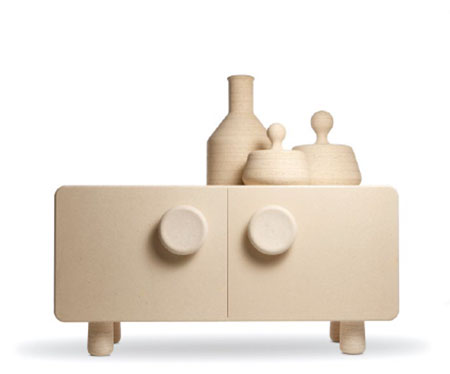
Many of my projects convey a message, whether explicitly or implicitly. Consider the Truciolari collection: its underlying idea is that any material, when treated with skill and care, can become precious. To communicate this, I combined chipboard—a familiar and widely used semi-finished material—with equally established processes such as manual turning and CNC milling. The result was a different kind of object, one that restored dignity to chipboard itself. The intention was to demonstrate that interesting and original outcomes can emerge even from materials commonly perceived as poor or less noble.
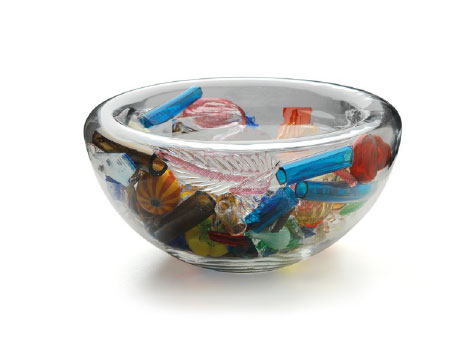
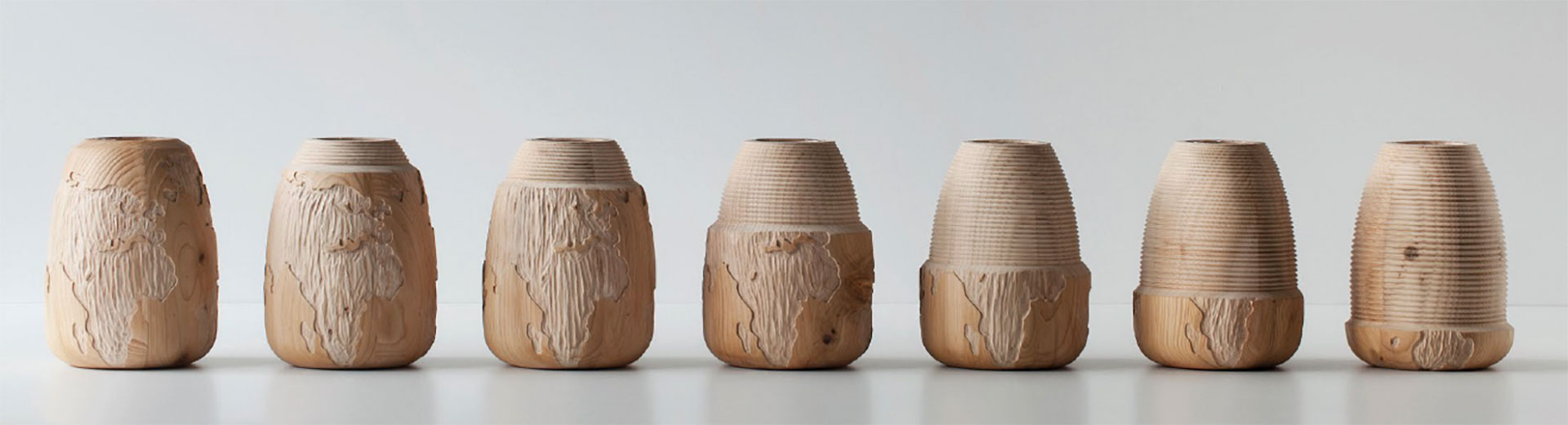
The message is even more explicit in the Earth Overshoot Day collection. I sought to visualise the depletion of our planet’s non-renewable resources through the gradual erosion of a world map. To tell the story of this alarming consumption, I created CNC-milled vases that were finished by hand using scraps of cedar veneer. To me, it is clear that the true function of these vases lies in the message they communicate.
What do you think about current discussions around geo-cultural design?
I certainly feel close to a design approach that considers the relationship between an object and the place from which it originates, but I do not feel the need to attach a label to that attitude. I believe a project should ultimately be judged by its quality; everything else seems secondary to me.
How would you define ‘empathetic design’? Is it a response to a particular cultural evolution, or a necessity that has always existed but has only now become explicit?
Personally, I do not feel entirely comfortable with this definition. I find it redundant and unnecessary, and I would not want my projects to be described in those terms. To me, it is self-evident that users’ needs—whether direct or indirect—should always be at the centre of a project.
If ‘surprise’ is a defining characteristic of your work—giving objects unexpected possibilities, as with the table/fan and armchair/suitcase—do you consider yourself more of an inventor than a designer?
In 2009, for the solo exhibition Lorenzo Damiani: Where Have All the Inventors Gone? at the Triennale di Milano, curator Marco Romanelli highlighted my inclination to merge functions through a form of typological contraction, in which form becomes the outcome of a more complex thought process. Silvana Annicchiarico later described my approach as a ‘design of surprise’, emphasising the sense of wonder and disorientation that some of my projects can evoke when first encountered. That said, I consider myself a designer.
What role can technology—and artificial intelligence in particular—play in a design practice that seeks to remain ‘human’?
When used appropriately by people with sufficient experience, artificial intelligence can certainly become a valuable tool. The problem arises when designers use it superficially, risking the homogenisation of ideas.
Your work Rainbow Without a Storm is an example of visual poetry. What role does the poetic dimension play in your design?
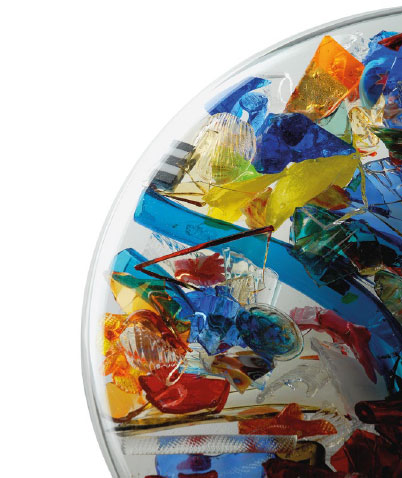
To be honest, I find this question rather difficult to answer. For me, every project must respond to a particular set of questions. The answers will vary according to the context, although certain recurring elements may be interpreted as a form of design poetry. I would rather share the secret of how to create rainbows. This project sought to reproduce the colours of the solar spectrum naturally, in a carefully selected location, creating the conditions for an authentic, non-artificial rainbow to appear. The intention was to preserve the poetic quality of light refraction and remain subject to the laws of nature, which alter the chromatic effects as the brightness of the day changes. All of this is Rainbow Without a Storm.
Lorenzo Damiani
BIO
Lorenzo Damiani (b. 1972, Lissone, near Milan) is an Italian furniture and product designer who graduated in Architecture from Politecnico di Milano. His work is rooted in a sustainable, material-driven approach. He has experimented extensively with marble and metal, seeking to minimise waste and maximise structural efficiency. Significant projects include the Aerea and Benna benches (Da A), and the Monolithos, Marmo Leggero and Boboli marble collections.
www.lorenzodamiani.net
Homa Design Magazine is a vibrant editorial venture on a mission to ignite the flame of design thinking across the entire Homa community—encompassing Homa people, our partners, and beyond! Yet, its influence extends beyond these boundaries; it serves as a beacon of design culture poised to illuminate our entire industry.
Today, it stands as a remarkable testament to the potency of tangential marketing, presenting a novel approach to captivating audiences. The magazine is the result of a collaborative effort, with the original idea stemming from Homa Europe.
Editor in Chief: Federico Rebaudo
Project Coordination: Federico Gallina
Contributing writers: Elena Scandroglio, Pierre Ley, Patrizio Cionfoli
Coordination, Design & Layout: Studio Volpi
For further information and Press Contact: info@homaeurope.eu
Copyright HOMA 2026- Issued By Homa Marketing dept. on August 2026
For further Information and Press Contacts: info@homaeurope.eu