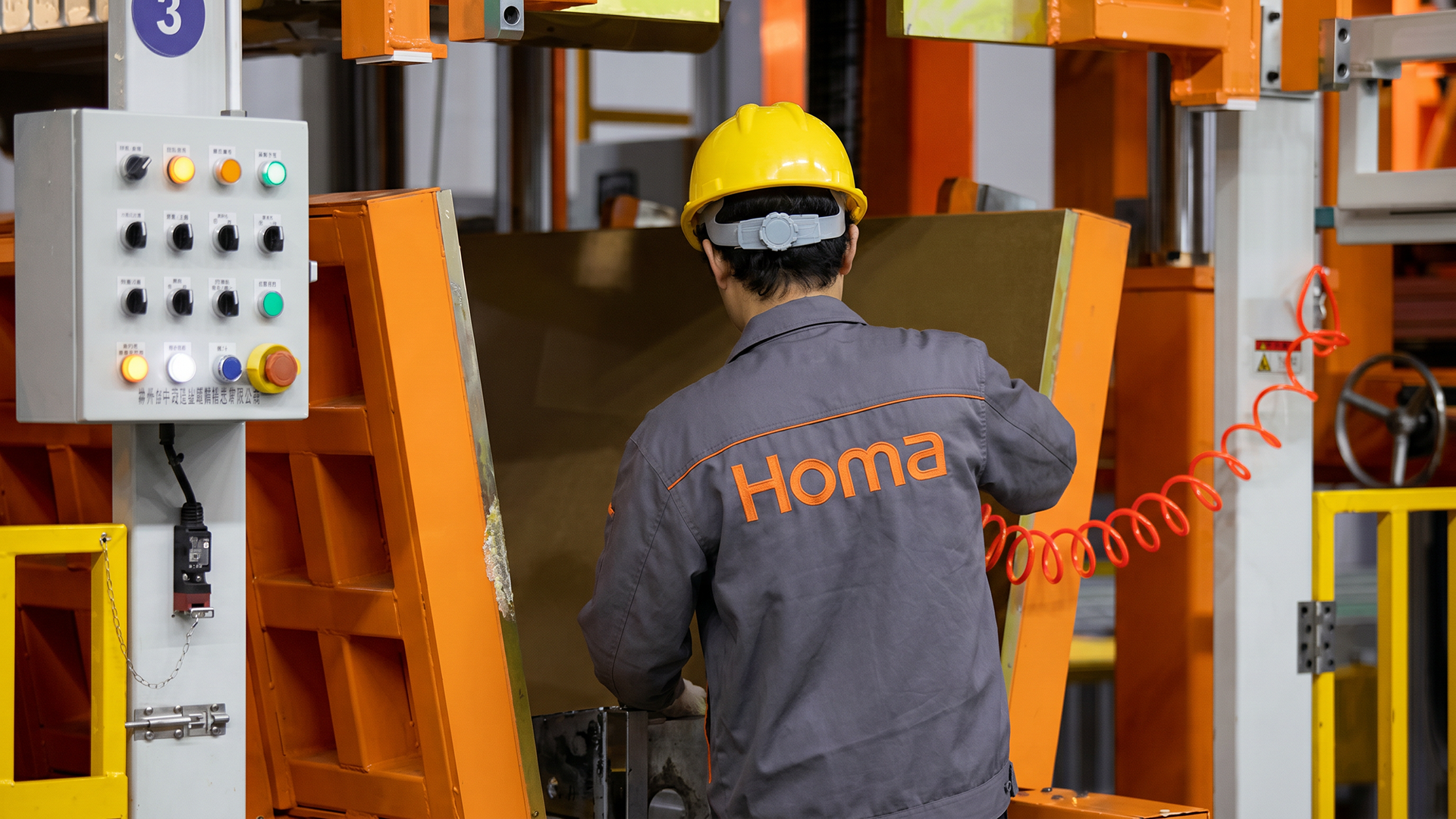
From systematic EHS audits and employee training to AI-enabled risk detection, Homa is embedding safety into the architecture of its expanding global manufacturing system.
MANUFACTURING • SAFETY • AI • OEM RELIABILITY
In advanced manufacturing, safety cannot remain a separate procedure, activated only during an inspection, an emergency or a dedicated campaign.
It must become part of the way an industrial organisation thinks, learns and operates every day.
As Homa’s manufacturing network continues to expand, the company is strengthening a systematic approach that connects environmental, health and safety management, employee awareness, equipment reliability and digital technologies.
The objective goes beyond regulatory compliance. It is to build an industrial environment in which people are better protected, risks are identified earlier and production becomes more stable, consistent and dependable for Homa’s global partners.
Today, Homa’s manufacturing network includes nine refrigerator plants and two freezer plants, while the company’s Thailand Production Hub is progressively coming into operation. For an industrial organisation operating at this scale, growth creates not only greater capacity, but also a greater responsibility to ensure that standards, knowledge and preventive practices can be applied consistently across different factories and production environments.

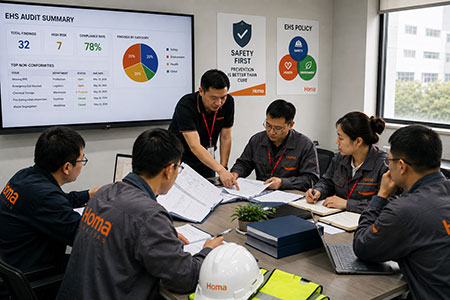
For more than a decade, Homa has conducted quarterly cross-factory Environmental, Health and Safety audits across its manufacturing sites.
The audits cover five principal areas: basic management, workplace safety, fire safety, occupational health and environmental protection. Supported by the ISO 45001 occupational health and safety management system and the ISO 14001 environmental management system, the process includes assessment, scoring, factory comparison and corrective action planning.
These internationally recognised frameworks support a structured approach to workplace risk and environmental responsibility. Further context is available from the International Organization for Standardization’s explanation of ISO 45001 and ISO 14001.
The value of Homa’s process, however, lies not only in identifying a problem within a single production site. When a risk is recognised in one factory, the experience can be reviewed, translated into preventive action and shared across the wider manufacturing network. Individual corrections can therefore contribute to stronger common operating standards.
In 2025 alone, Homa conducted more than 370 safety inspections across its manufacturing operations. This closed-loop method transforms safety management from a succession of isolated interventions into a continuous process of observation, correction, knowledge sharing and organisational improvement.
Digital transformation is opening a new chapter in industrial safety.
As part of its wider smart manufacturing roadmap, Homa has introduced AI-enabled visual recognition technologies in selected production areas to support earlier identification of potentially unsafe situations.
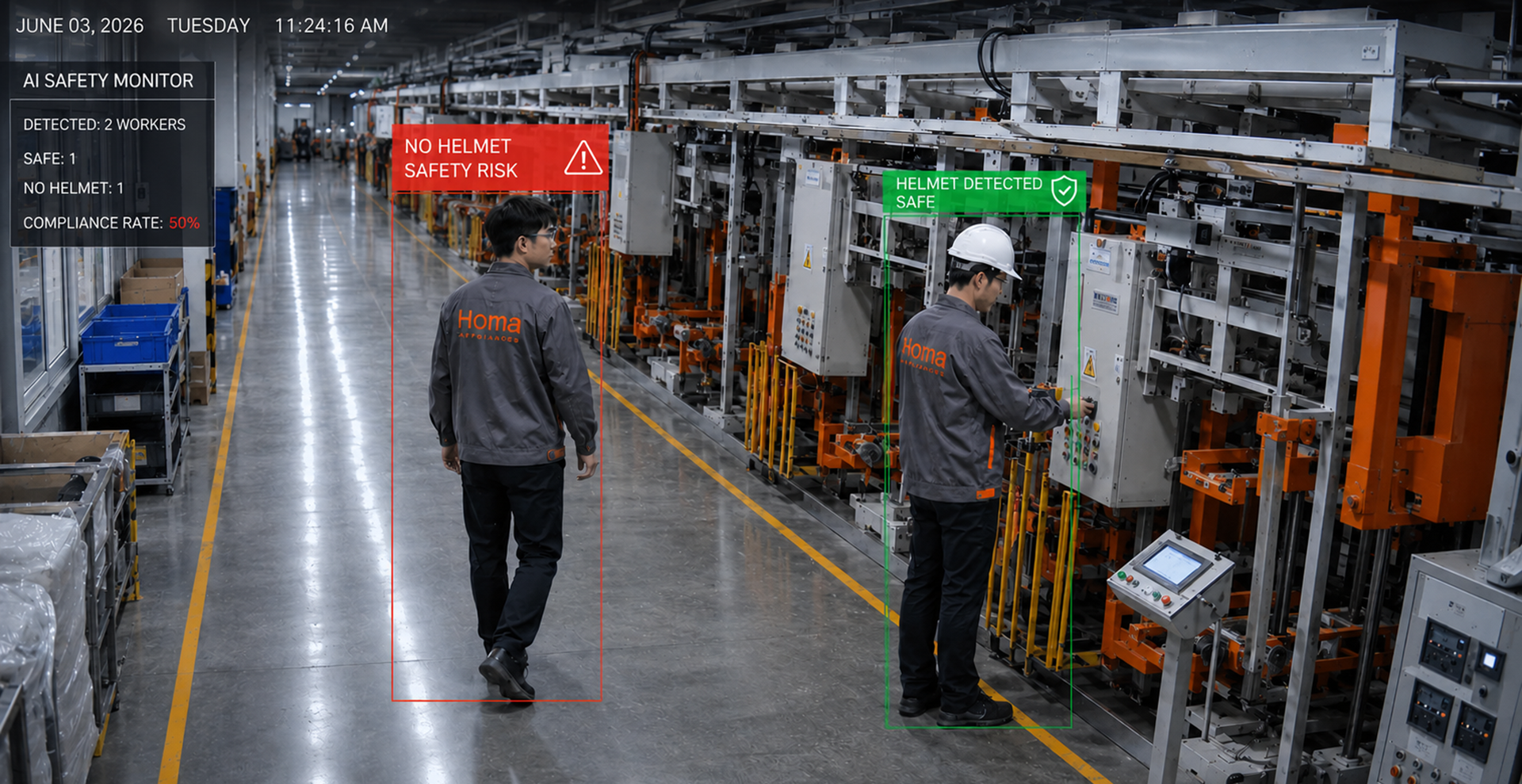
The systems can recognise conditions including missing safety helmets, open flames, unauthorised entry into restricted areas and smoking in non-designated zones. When an abnormal situation is detected, an alert is transmitted through Homa’s internal communication platform to the relevant on-site safety personnel.
The role of artificial intelligence is not to replace professional responsibility or human judgement. Its value is to extend visibility and support faster intervention.
By combining real-time digital recognition with the experience of safety teams and production personnel, Homa is moving part of its safety management from retrospective correction towards active prevention.
This reflects a broader principle visible across Homa’s Factory No. 9 manufacturing model: technology creates value when it strengthens human capability, improves decision-making and makes complex industrial systems more responsive.
Even the most advanced detection system cannot replace awareness, responsibility and daily behaviour.
For this reason, employee education remains a central part of Homa’s safety management system. All new employees receive training covering safety awareness, emergency response and practical fire-fighting skills. This initial preparation is reinforced through continuous occupational health and safety programmes integrated into everyday factory management.
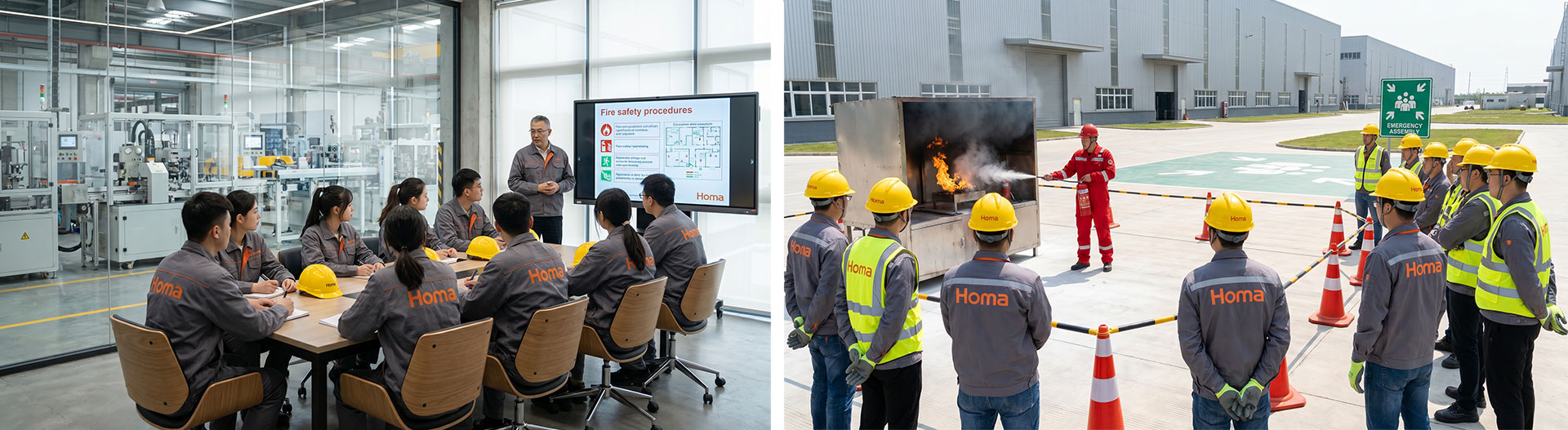
Across Homa’s manufacturing sites, more than 500 occupational health and safety training sessions are delivered each year, representing over 146,000 employee participations.
The scale of this activity reflects an important distinction: safety is not created by communication alone. It is built through repetition, practical experience and the ability of people to recognise risks, respond appropriately and understand the consequences of their actions.
A strong safety culture emerges when employees do not simply follow a rule, but understand why it matters—to themselves, to their colleagues and to the wider organisation.
This people-centred perspective is consistent with Homa’s broader CARE culture. Care in manufacturing is not an abstract corporate value. It becomes visible in the attention given to working conditions, employee development, operational discipline and the protection of the people who make industrial performance possible.
Manufacturing efficiency is frequently associated with speed, continuity and output. Yet responsible industrial management also requires the ability to pause.
Each year, Homa schedules a planned maintenance period to inspect equipment, address potential risks and reinforce preventive maintenance across its production operations.
This time is not considered separate from productivity. It is part of the foundation that makes reliable productivity possible.
Well-maintained equipment supports safer working conditions, greater process stability and more consistent product quality—an approach also reflected in Homa’s broader account of the company’s manufacturing ecosystem. It also reduces the risk that a preventable technical issue may develop into a disruption affecting people, production or delivery.
In this sense, safety and efficiency are not opposing priorities. A safer production system is generally a more stable system. A more stable system provides greater consistency. And consistency is one of the foundations of trust between an OEM manufacturer and its partners.
The relevance of manufacturing safety extends beyond the factory itself.
For Homa’s clients—manufacturers, importers, retailers and private-label specialists across international markets—the reliability of an industrial partner depends on much more than production capacity.
It depends on the ability to manage complexity, protect continuity, maintain consistent standards and reduce operational risk across the complete manufacturing process.
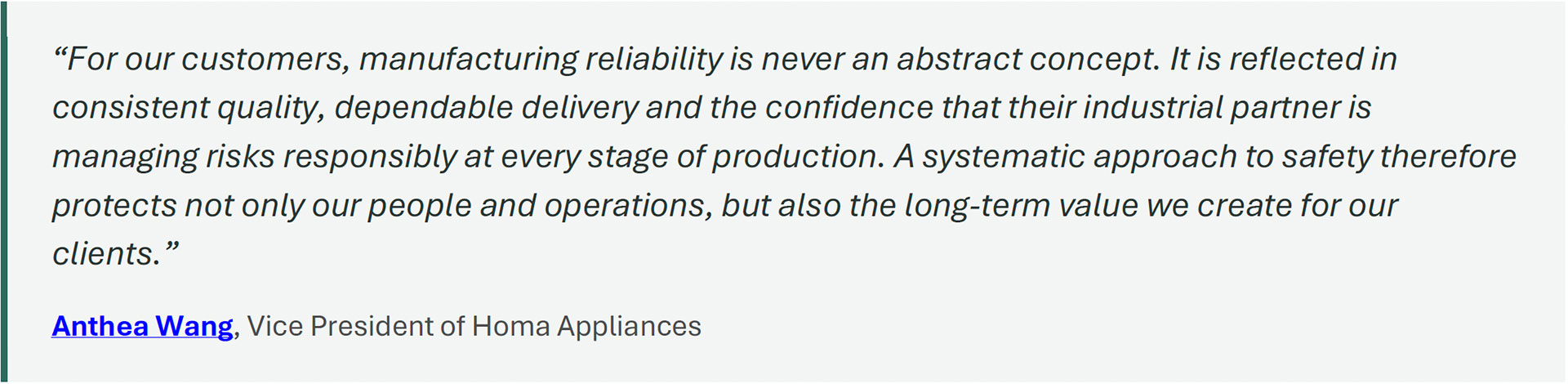
For Homa’s international audience, much of the work supporting this reliability necessarily remains behind the scenes.
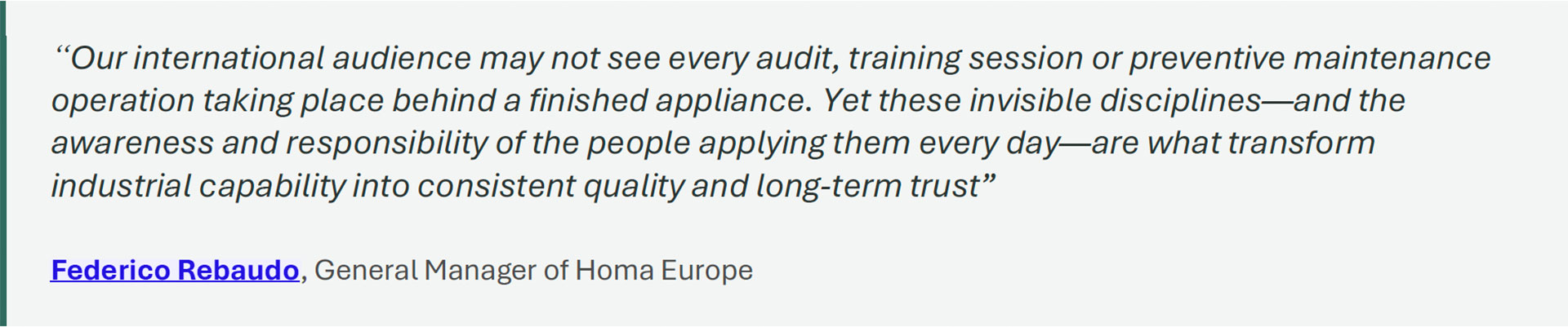
This is particularly important in an OEM relationship.
Homa manufactures products that will ultimately carry the identity and reputation of its clients’ brands. Industrial responsibility therefore means protecting not only Homa’s operations, but also the expectations, commitments and market credibility of every partner served by those operations. This relationship between manufacturing discipline and customer value is also central to Homa Europe’s perspective on quality in an OEM environment.
Systematic EHS audits, AI-enabled alerts, employee training and preventive equipment management are individual elements of a wider architecture. Together, they connect people, machines, data and management responsibility.
They make safety present not only in policies and reports, but in the way production lines operate, employees behave, factories learn and industrial decisions are made.
The future of manufacturing will be increasingly digital, automated and interconnected. But the true measure of industrial progress will not be the amount of technology installed. It will be the ability of technology, processes and people to create manufacturing environments that are safer, more intelligent and more dependable.
For Homa, this means continuing to develop safety with the same systematic attention given to quality, innovation and delivery.
Because safety is not simply one indicator of responsible manufacturing. It is part of the infrastructure that allows manufacturing to earn trust.
Copyright HOMA 2026- Issued By Homa Europe Communication Team - An editorial perspective on safety, smart manufacturing and industrial reliability across Homa’s global manufacturing network.
For further Information and Press Contacts: info@homaeurope.eu