A conversation with Rod White on materials, domestic technology and the changing relationship between people and everyday electronics.
EDITOR’S NOTE
By Federico Rebaudo, Editor-in-Chief of Homa Design Magazine and General Manager of Homa Europe
This conversation connects directly with a principle that guides my work at Homa: design is relevance. It is where industrial capability, material intelligence and human experience meet.
Homa Design Magazine was created to explore this intersection. Not simply to discuss products or aesthetics, but to understand how industrial culture, technology and design influence the way people live. In an OEM context, this perspective is particularly important. Technology becomes meaningful not when it merely performs, but when it interprets real behaviours, domestic rituals and human needs.
Rod White’s reflections bring this idea into sharp focus. His work shows how materials, light, proportion and restraint can soften the presence of technology, allowing it to belong more naturally in the home.
For Homa, the conversation also brings our three pillars together: Design, through products that belong naturally in people’s lives; Food Preservation, through technology that supports everyday wellbeing; and Care, through longevity, clarity and respect for people and resources.
This is the perspective I hope Homa Design Magazine can continue to develop: a space where technology is examined not only for what it can do, but for the quality of the relationship it creates with people.

Many technologies are experienced long before they are used. Before a button is pressed or a screen lights up, something has already clicked in the consumer’s mind. We have noticed the object. We have registered the material, the texture, the way it sits in a room, the atmosphere it creates around it. That first encounter often determines how we feel about a product. In that sense, technology does not begin with interaction.
The conversation with Rod White
In your work, you don’t simply design the “box” of a product. You shape how it is perceived and experienced in an environment. When does a material, a texture or a finish become the true interface between technology and people?
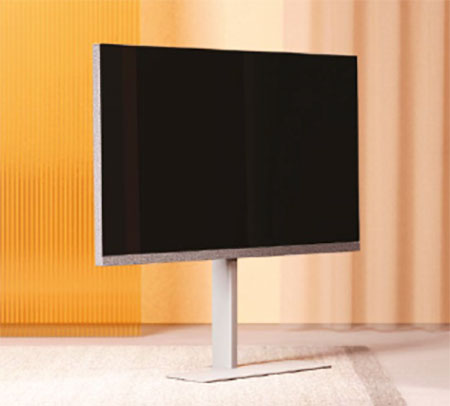
One example I often think about is the work we have been doing over the last eight or nine years with Kvadrat, the wool fabric manufacturer from Denmark. We apply their fabrics to televisions but also to speakers and headphone products.
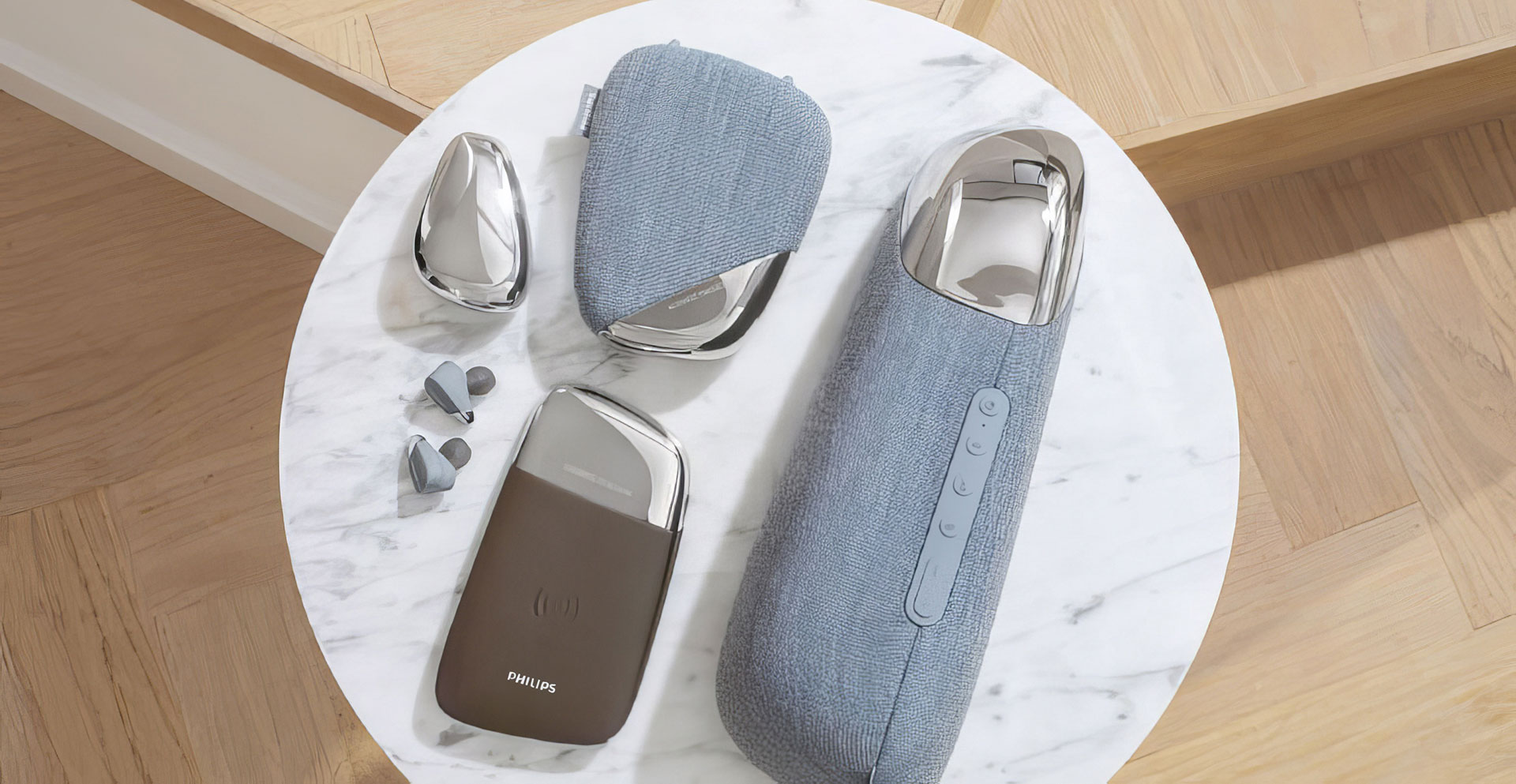
When you wrap fabric around a three-dimensional object such as a Bluetooth speaker, the perception changes immediately. From a distance it already looks different from the normal technical consumer electronics wrap. We deliberately choose a melange fabric where multiple colours come together. It creates visual depth.
Then when you get up close, the haptic feedback from the wool fabric gives reassurance to the user that this is real quality. It resonates with a sense of premium and it delivers on the brand promise.
Another example is light. Light signatures
In the case of our televisions and monitors we also have light spill on the back wall. Our Ambilight system spreads the colours of the TV content onto the wall behind the screen. It gives you a much larger immersion space. So the experience between user and product becomes product plus. It goes beyond the product.
While many consumer tech brands have pursued a futuristic aesthetic, your work has often moved in the opposite direction, making technology feel more domestic, almost as if it could disappear into the home.
Internally we have used the terms home fit as drivers for a long time. At the same time we also talk about objects of desire. When we can create a product that you want more like an object or like a piece of furniture, then we are getting somewhere.
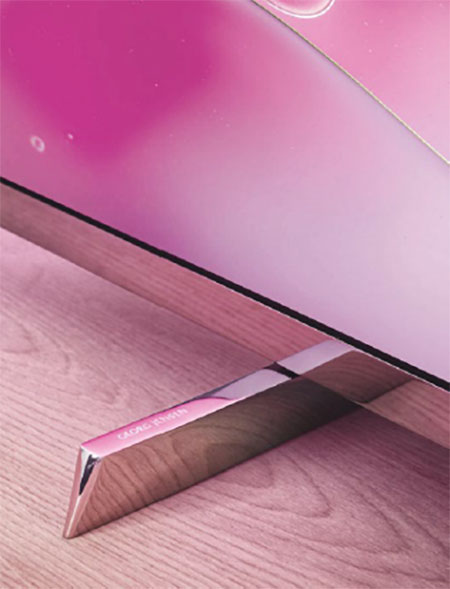
If we go back twenty years, the push was for high gloss plastics and chrome metals. In the traditional audio space you also had brushed and radial spun aluminium. Finishes that attract light. We played that game for many years.
One driver that changed this was sustainability. We deliberately moved away from chrome applications because they are not good for the environment. With that we moved more as a brand towards finishes that are simpler, ideally with no secondary finishing, using tones and materials that create less contrast and fit better into the domestic space.
Previously, you’ve lived and worked in Tokyo, Singapore, Vienna and Eindhoven and you have spent a large part of the last decade in China. How did these different cultures reshape your understanding of comfort and domestic space?
Moving to Japan was probably the biggest shift in my learning. I moved from a European furniture starting point into a Japanese context where unspoken craftsmanship drives everything. The engineering quality is incredible and I learned a lot from that. I also learned about proportion and balance, which come from Japanese philosophy.
When I moved back to Europe I realised there is a lot of commonality between Northwest Europe and Japan. That is why the expression Japandi exists. The beauty of Europe is that there is not just one Europe. There is the more austere Northwest Europe but also the more playful and colourful South of Europe.
For a brand like Philips that is interesting because people across the world often do not know where it comes from. The British sometimes think it is British, the French sometimes think it is French. That allows us to leverage different aspects of European design.
Consumer electronics are gradually shifting from a purely technical language to a warmer, more home-oriented one. Where do you see this evolution taking us?
If you look back, televisions and radios were once pieces of furniture. Manufacturers used to make wooden cabinets for them. Then in the 1980s there was the peak of racks of silver or black technology, with too many cables and too many buttons.
Today the technology push is clearly towards bigger screens and more screens. At the same time wireless technology allows much less cabling and much more connectivity.
The other side of the change comes from people. While the basic needs of information, communication and entertainment do not change, people want to have that content where they want it and when they want it. Different generations within the same household are using different devices. Some are using screens, others headphones. So there is an opportunity to deliver objects that do not take up more visual space than necessary.
When technology starts behaving more like furniture within the home, the design team itself must evolve. What new competencies are you building around product development today?
The core design team is mostly product with CMF (Colour, Material, Finish), but we also have a sustainability officer and an acoustic engineer on hand as a core team. But then we can also reach outside. A lot of the designers are actually either coming from furniture like myself, but also automotive. So depending on the client that we’re working for, we can extend the team whether it’s on user experience requirements or motion study.
I’ve read that you designed many pieces of furniture in your own home. Did that experience influence the way you approach appliances?
It did not really change things because furniture design was where I began. The need for longevity is consistent, and when the client is yourself you obviously have to deliver that. Applying CMF across the whole home palette was an interesting challenge, but the process was actually very similar to work. You define the target, the costing, the materials and the suppliers. So the similarities are quite strong.
High-end furniture is often designed to last for generations. How do you position yourself in the debate around planned obsolescence in consumer technology?
In the end brands are out to make profit, bottom line, and the consumer is out for a great product at a good price. Finding the space in the middle is where we need to operate and excel.
One of the good things about designing European products within the context of a European brand is that we also have to adhere to European legislation. As a Philips brand we were already studying sustainable solutions twenty-five years ago. Fifteen years ago we created the Eco TV, which used recycled aluminium, brown-box packaging and even the world’s first Solar Remote Control. There have been many cases where interesting studies were done, but today Europe is demanding certain connectors for smart devices, less polystyrene and more sustainable materials.
By now our audio products and our monitors contain around eighty-five percent post recycled plastics. Increasing that percentage is a target we have across all our categories.
Sustainability is driving the company. It is not always the most profitable path, so there is not always an easy alliance between what is best for the planet and what works for the business. But if you can prove to consumers that you are more sustainable than the competitor, it is going to help.
There’s a line that says: “objects should keep us company”. Do you agree?
Sometimes even too much company. There is a growing realisation that handheld smart screens can become too much of a companion. People become addicted to scrolling, whether it is doom scrolling or something else.
That said, if products are designed well they can create strong emotional connections. Occasionally we see televisions or headphones where people become very passionate about them. They create websites around them, they talk to other people about repairing them and it becomes something of a cult.
For example, about forty years ago Philips created a youthful audio range with bright yellow colours and bold accents. It became something of a tribe. People wore the products on their shoulders at street parties. That kind of connection really struck a chord at the time.
We are living in an era of constant notifications and fragmented attention. Do you feel this pressure when designing home technology?
Human behaviour has changed. If you watch films from forty or fifty years ago the pace is much slower than it is today. People are able to absorb information much faster. Even in sports, high-level athletes are training with gaming devices to improve reaction times.
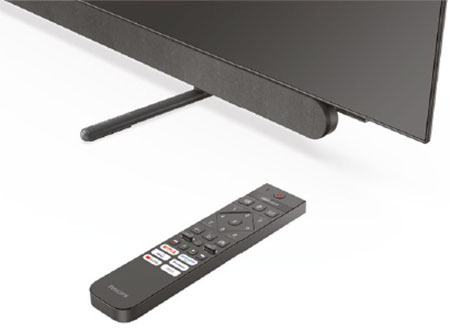
When we design products we assume that people of many different ages should be able to interact with them easily. For example we spend a lot of time designing remote controls. We probably spend more time on the remote control than on the television itself.
The goal is to simplify the interface. The basic functions should be immediately accessible. At the same time more advanced functionality can be available if the user wants it. In a way we try to mask the complexity of the technology until the user decides to access it.
Final question. How is the idea of luxury changing in consumer technology today?
The answer is quite complicated because luxury has become much wider.
Through our external client work we sometimes design products for extremely wealthy customers such as super yacht owners. Their expectations are very different from those of a normal consumer. At the extreme end you may find audio systems that cost several million euros. In those cases luxury is about exclusivity. But luxury can also mean something else entirely. Some people want a home environment where technology is almost invisible.
For mainstream consumers the situation is different again. The core technology has become much more accessible. Today many people can afford a sixty-five-inch television with a soundbar. From that point the experience can scale upwards depending on how far someone wants to go.
In that sense luxury has become broader. The possibilities are wider than they used to be.
BIO
Rod White is CEO and Chief Design Officer at Amsterdam Design Office.
In his role, Rod is fully responsible for all creative direction, design strategy, team development and leadership for the design teams based in Amsterdam, Taipei and Shenzhen.
The design team creates an all consumer touchpoint design experience, which starts with consumer behavioral research to identify potential new product proposals. These are then further validated together with the product category management to identify future range extensions.
In parallel they create annual Product Design Identities, online, in-store and exhibition space direction setting.
As part of the role, he is the face of TP Vision for all design related global media events and has been a design keynote speaker in Design events throughout the world.
Externally he leads A.D.O. providing design services and consulting towards several global consumer facing brands.
His design leadership has also been recognised through multiple international awards, including the 2026 Red Dot distinctions for Philips TV & Sound.
Homa Design Magazine is a vibrant editorial venture on a mission to ignite the flame of design thinking across the entire Homa community—encompassing Homa people, our partners, and beyond! Yet, its influence extends beyond these boundaries; it serves as a beacon of design culture poised to illuminate our entire industry.
Today, it stands as a remarkable testament to the potency of tangential marketing, presenting a novel approach to captivating audiences. The magazine is the result of a collaborative effort, with the original idea stemming from Homa Europe.
Editor in Chief: Federico Rebaudo
Project Coordination: Federico Gallina
Contributing writers: Elena Scandroglio, Pierre Ley, Patrizio Cionfoli
Coordination, Design & Layout: Studio Volpi
For further information and Press Contact: info@homaeurope.eu
Copyright HOMA 2026- Issued By Homa Marketing dept. on August 2026
For further Information and Press Contacts: info@homaeurope.eu