High-Pressure and Nanotech’s Fresh Take on Food Preservation.
In a world increasingly focused on sustainability and reducing waste, food preservation plays a crucial role. Each year, a significant portion of produced food is lost to spoilage, which not only causes economic loss but also puts a strain on environmental resources. Consumers today demand foods that are not only safe and long-lasting but also retain their natural freshness, flavour, and nutritional benefits without relying on synthetic additives. This rising demand has spurred innovation within the food industry, leading to advanced technologies such as High-Pressure Processing (HPP) and nanotechnology that are revolutionising preservation and packaging.
High-Pressure Processing (HPP): The gentle giant of preservation
High-Pressure Processing, also known as Pascalisation or High Hydrostatic Pressure, is a non-thermal method
that inactivates microorganisms and enzymes by applying immense pressure to food products, often between 400 and 600 MPa. To put that figure into perspective, imagine standing beneath the weight of about four to six thousand times the pressure of the atmosphere we experience daily, roughly the force you’d feel if you were crushed by a column of water taller than a skyscraper pressed down on you in an instant.
HPP involves sealing food in flexible containers like pouches or bottles, which are then placed in a water-filled chamber. Pumps apply pressure uniformly across the chamber, transmitting force through the water and onto the food. This process causes only a minimal temperature increase (around 3 degrees Celsius per 100 MPa), which then quickly reverts once pressure is released. Unlike heat-based methods, HPP preserves the food’s original characteristics, taste, texture, colour, and nutrients by primarily disrupting hydrogen bonds without affecting covalent bonds. Think of molecules in food like building blocks connected by different types of links.
Hydrogen bonds are like temporary, weak connections that hold things together loosely, like Velcro ribbons. Covalent bonds are stronger, permanent connections, like glued-together bricks.
When high pressure disrupts hydrogen bonds, it’s like pulling apart the Velcro ribbons without tearing the bricks apart.
This helps inactivate certain microbes without damaging the main structure of the food molecules.
The advantages of HPP are substantial.
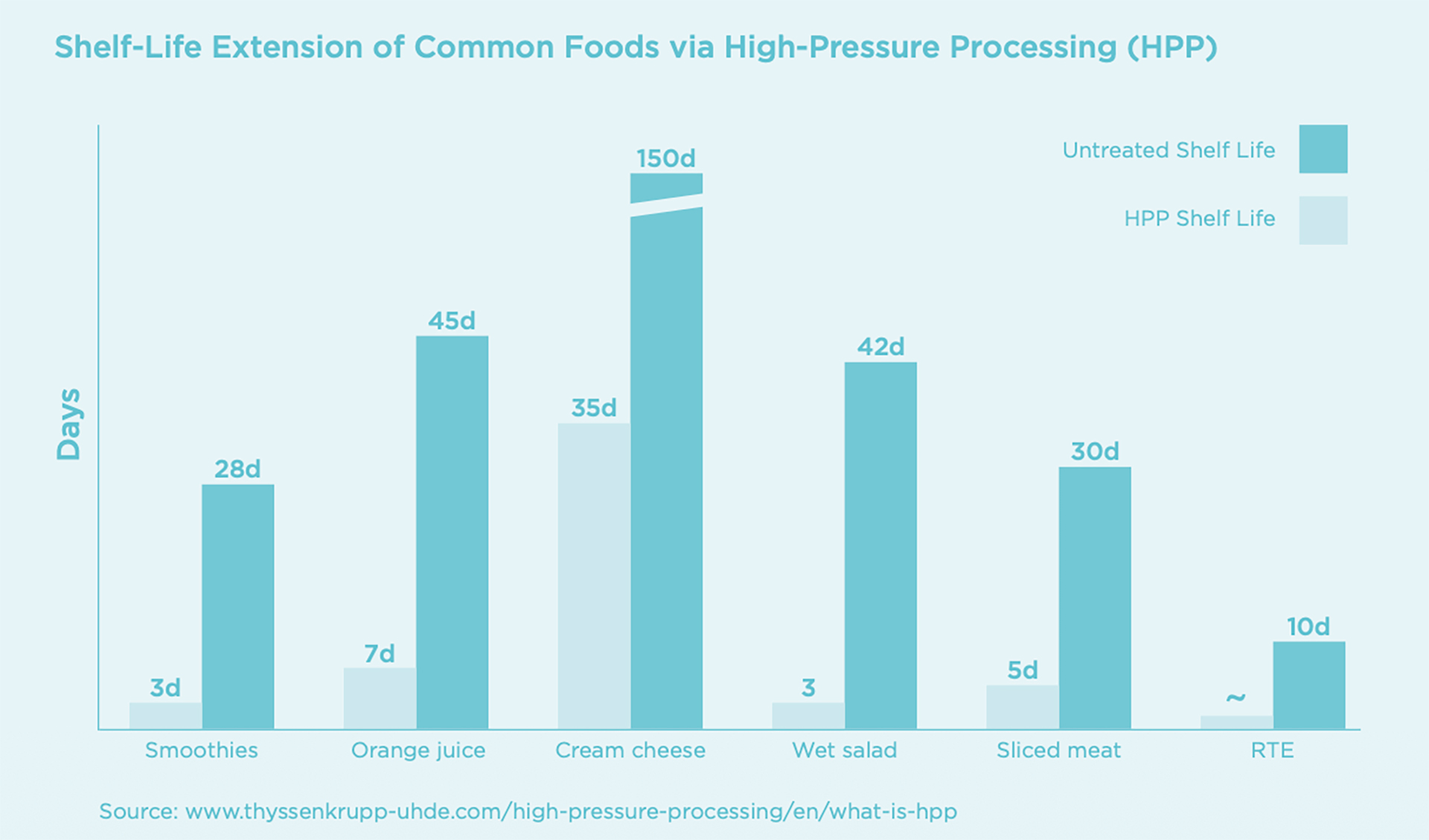
It extends shelf life by destroying spoilage microbes and certain enzymes, sometimes up to 120 days depending
on the product, while maintaining the food’s fresh-like qualities. This makes it particularly suitable for products like juices, guacamole (whose shelf life can increase from 3 to 30 days), seafood, deli meats, sauces, jams, pet foods, and baby foods. Acidic foods with pH below 4.6 are especially compatible because their low pH inhibits the growth of pressure-tolerant spores.
HPP also enhances food safety by effectively inactivating pathogens such as Listeria, E. coli, Salmonella, and Vibrio. It supports the market trend for clean- label products by reducing or removing the need for chemical preservatives.
Food products treated with HPP also experience less waste due to extended freshness and spoilage resistance.
Moreover, certain applications, like shellfish meat separation, are uniquely facilitated by HPP, making processes
easier and safer.
However, there are limitations. The high initial investment, ranging from half to several million dollars, and the
need for specialised flexible packaging that can withstand volume reductions during pressurisation pose barriers.
Rigid containers like glass or cans are unsuitable. Furthermore, at room or chilled temperatures, HPP does
not inactivate bacterial spores; thus, low-acid foods containing spores often require refrigeration during
distribution to prevent germination.
Foods with entrapped air, such as bread or marshmallows, deform under pressure, making them incompatible.
Dried products like spices are also poor candidates because the microbial kill rate diminishes with low moisture levels.
Innovations continue, with combining HPP with mild heat—known as High-Pressure Temperature or Pressure-
Assisted Thermal Sterilisation, achieving spore destruction and enabling shelf- stable low-acid foods. Regulatory
agencies like the FDA have approved some of these combined methods for specific foods. As technology
advances, costs decrease, and consumer acceptance grows, opening the door to broader adoption.
Nanotechnology: The microscopic guardians of food
Complementing HPP, nanotechnology is opening new frontiers in food preservation and packaging through the
manipulation of materials at the scale of 1 to 100 nanometers (1 nanometer is about 10,000 times thinner than
a human hair). Its applications are categorised into two main types: direct integration into food products and
indirect uses such as smart packaging with nanosensors.
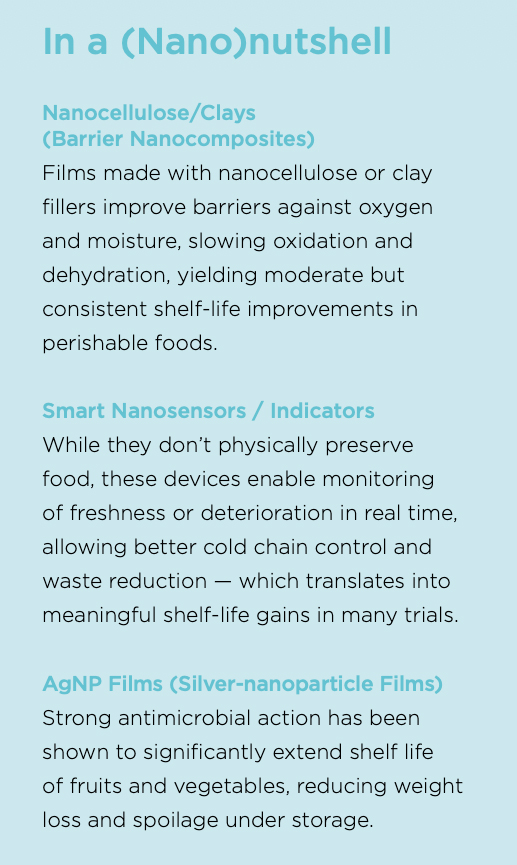
In packaging, nanomaterials like silver or copper nanoparticles are embedded into films to actively combat spoilage organisms. These particles release ions that kill bacteria and molds, thereby keeping foods fresh for longer periods. Titanium dioxide nanoparticles can remove ethylene gas in storage environments, delaying ripening and browning in fruits. Such active packaging creates antimicrobial and antioxidant barriers around food items, significantly slowing spoilage processes and extending shelf life.
Nanotechnology also enhances packaging barriers. Incorporating nanoscale additives into materials makes it more difficult for oxygen and moisture to penetrate, thus preserving the food’s quality for extended periods.
This “lengthens the tortuous path” that gases and water molecules must traverse, which reduces permeability and contributes to cost savings and waste reduction.
Smart packaging takes nanotechnology further through nanosensors that monitor food status in real time.
For example, sensors integrated into packaging can detect spoilage gases like biogenic amines or toxins such as
aflatoxin B1 in milk. These nanosensors can change colour to alert consumers or producers about the food’s freshness.
They are also capable of measuring environmental factors like temperature, humidity, and light, providing continuous feedback with devices such as the ‘iSTrip’, which records temperature history and helps track the conditions the food has been exposed to during storage and transport. This real-time monitoring enables better control over food safety and quality.
Beyond packaging, nanotechnology improves the food itself through nanoencapsulation, where bioactive
compounds such as vitamins, antioxidants, preservatives, probiotics, and omega-3 fatty acids are enclosed
within nanoscale capsules. This technique provides a protective barrier, enhancing stability, prolonging shelf life,
enabling controlled release, and masking undesirable tastes or aromas. Products fortified with
nanoencapsulation include fruit juices with added vitamins and flavoured items like chocolates and teas
with nanoclusters. Nanoencapsulation also increases bioavailability, meaning that nutrients are absorbed more
efficiently by the body, improving their health impact.
Nanoemulsions are another crucial application. They are fine dispersions of one liquid within another at the
nanometer scale, improving the texture and consistency of foods such as ice creams, beverages, and sauces.
The smaller droplet size leads to a larger surface area, facilitating better digestion and absorption of lipophilic
nutrients like beta-carotene and fat- soluble vitamins. Nanoemulsions also provide antimicrobial benefits, useful for reducing microbial contamination in food and packaging materials.
The combined benefits of nanotechnology include extending shelf life, enhancing food safety through active spoilage control and detection, reducing food waste, improving sensory qualities like taste and texture,
and boosting nutritional content with fortified, highly bioavailable ingredients.
Additionally, nanotechnology supports environmental sustainability by aiding the development of biodegradable, eco- friendly nanocomposite packaging that helps mitigate the ecological footprint of traditional plastics.
Regulation and safety: the balancing act
Regulation and safety are critical issues in deploying these advanced nanotechnologies. While high-pressure
processing has been extensively assessed and recognised as safe by agencies such as the European Food
Safety Authority (EFSA) and the US Food and Drug Administration (FDA), nanotechnology presents more
complex challenges due to its novel properties and potential risks. EFSA has updated its guidance on nanomaterial evaluation, emphasising the importance of understanding their physicochemical properties, potential for migration into food, bioaccumulation, and toxicity.
A major concern with nanomaterials is their ability to migrate from packaging into food, which can lead
to bioaccumulation in humans. Studies have shown that certain nanoparticles, such as silver, can cause cellular damage, generate reactive oxygen species (ROS), and induce genotoxicity. Other nanoscale structures like zinc oxide or carbon nanotubes have been linked to toxicity in organs such as the lungs, liver, and kidneys. The lack of comprehensive long-term health data and standardised testing methods complicates risk assessments. Environmental impacts are also notable; nanomaterials can migrate into ecosystems, potentially harming
marine life and contaminating soil. The manufacturing processes for some nanoparticles can produce harmful by- products, further emphasising the need for strict oversight.
In response, regulatory bodies worldwide, including the European Union, the United States, and global organisations, are working to establish frameworks governing nanomaterials in food. The core principle is the
precautionary approach, meaning nanomaterials should only be introduced after thorough safety evaluations.
Regulations focus on preventing toxicity, ensuring nanocomponents do not alter sensory or nutritional qualities, and setting safe dose limits. Developing international standards and sharing knowledge across borders is crucial
for responsible development and implementation.
Nano-pressing the boundaries: a future without waste?
In conclusion, advances such as High-Pressure Processing and nanotechnology stand at the forefront of food preservation innovation. HPP offers a clean, non-thermal method that maintains nutrients and flavour while significantly extending shelf life.
Nanotechnology introduces active, smart systems that protect, monitor, and enhance food products through nanosensors, nanoencapsulation, and improved packaging barriers. Yet, these promising technologies must be built on rigorous scientific research, sound regulatory frameworks, and responsible application. As long-term safety and environmental impacts are better understood through ongoing study and collaboration, these innovations will help create a safer, more sustainable, and more flavourful food supply. The journey toward smarter, safer, and more sustainable food systems has only just begun, this time one macro-step at a time and free of pressure.
Copyright HOMA 2026- Issued By Homa Marketing dept. on May 2026
For further Information and Press Contacts: info@homaeurope.eu