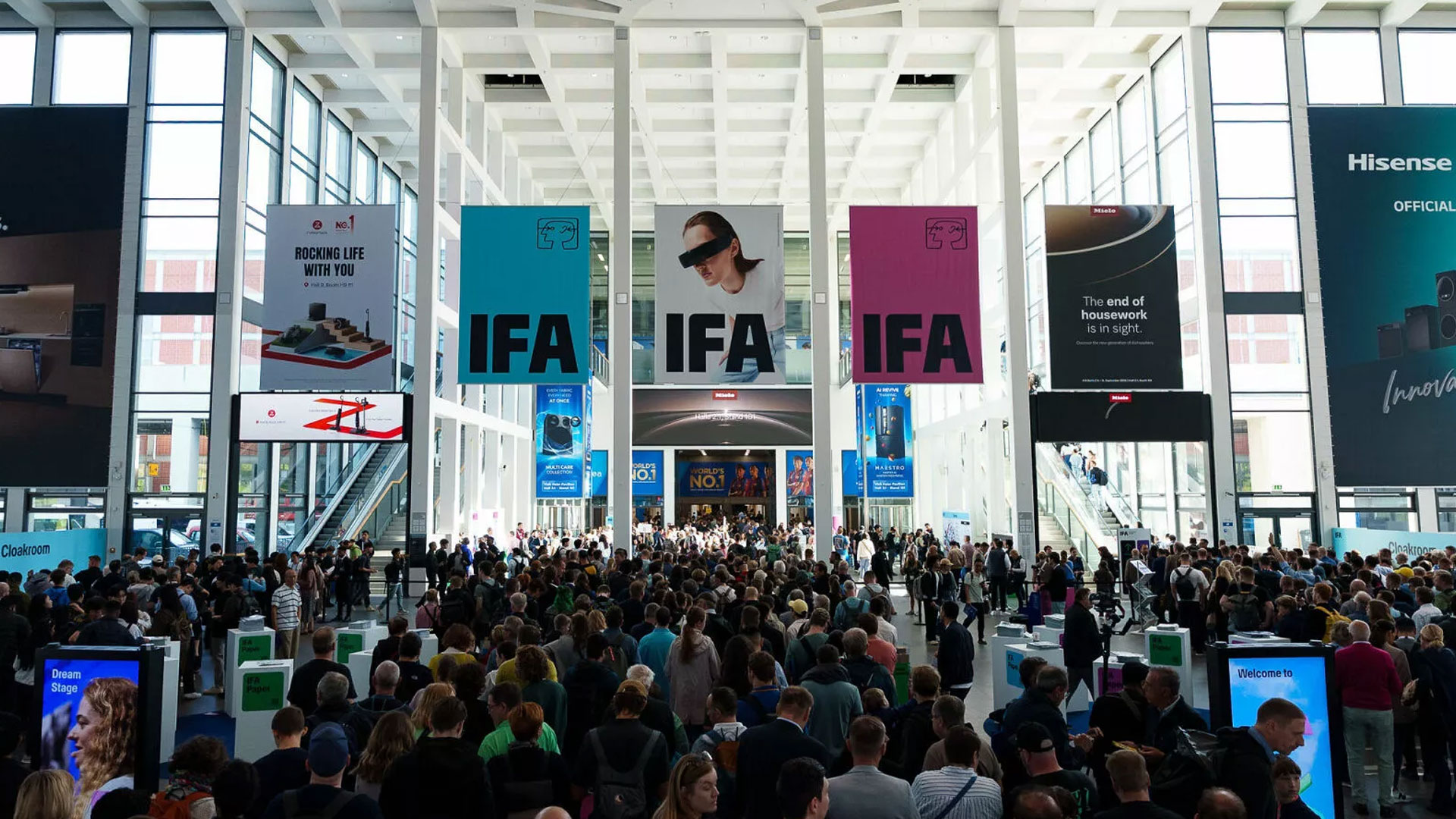
After three days at IFA 2026, the most relevant signal is not the number of innovations on display. It is the industry’s attempt to translate technology into benefits people can understand: more usable space, better food preservation, lower consumption and AI that still needs to prove how intelligent it really is.
By Federico Rebaudo General Manager at Homa Europe.
After three intense days in Berlin, meeting partners, exchanging perspectives and discussing where the market is heading, I am leaving IFA with one clear impression: technology is searching for meaning.
This does not mean it has already found it.
Recent reporting on the home of the future at IFA describes an industry moving beyond the smart home towards an intelligent home that learns, adapts and anticipates. The exhibition halls are filled with artificial intelligence, connected ecosystems, automation and promises of homes capable of anticipating our every need. Yet behind the language of innovation, a more important question is beginning to emerge: What does this technology actually change in people’s lives?
This may be the most significant conversation taking place in Berlin.
Technology can no longer be measured simply by counting features. An additional function is not necessarily an innovation, and it does not automatically create value. It becomes meaningful when it solves a recognisable problem, reduces effort, prevents waste or delivers a benefit that people can understand and experience.
In cooling and food preservation, one of the strongest signals is the focus on increasing usable internal volume without increasing external dimensions.
European homes are not becoming larger. Kitchens are increasingly designed as integrated systems, where every centimetre matters. The challenge is therefore not simply to build bigger appliances. It is to create more useful space within the same footprint.
More advanced insulation, redesigned components, reduced door-clearance requirements and more flexible interiors can increase capacity while respecting the physical constraints of the kitchen.
This may appear less spectacular than a large display or a conversational assistant. In reality, it is a good example of technology with meaning: it addresses a real limitation and produces an immediately understandable benefit.
But capacity should not be reduced to a headline number. The relevant measure is how much usable space can be created for every external centimetre — and how effectively that space responds to the way people actually shop, cook and live.
Innovation becomes visible when consumers can imagine what they will be able to store and preserve better, not when they are simply presented with another technical specification.
A refrigerator is gradually becoming more than a machine that produces cold. It is becoming a food-management and preservation system.
Temperature stability, humidity control, differentiated zones and faster recovery after the door is opened are not entirely new technologies. What is changing is the way their value is expressed.
The conversation is moving from technical performance to meaningful outcomes: additional days of freshness, better food quality, more freedom when planning meals and less waste.
This is an important cultural shift.
Food waste will not be reduced by adding another sustainability statement to a product page. It will be reduced by helping people preserve what they buy, understand what they already have and use ingredients before they are forgotten.
The sensor itself is not the innovation. The outcome enabled by that sensor is.
Artificial intelligence is, unsurprisingly, everywhere at IFA. Industry previews published ahead of the show already suggested that manufacturers would need to become more intentional about how AI is integrated into everyday products. AI has become the common language of the technology industry and, precisely for this reason, risks becoming meaningless.
Some applications remain conventional automation presented under a new name. Others are interesting but require more attention from the user than they give back. If an intelligent system must be continuously configured, corrected and supplied with information, it may not yet be particularly intelligent.
The more credible applications are often the quieter ones. This emphasis on practical usefulness is also reflected in editorial assessments of the most relevant products shown in Berlin, where usefulness and potential influence mattered alongside novelty.
They understand context, learn selected usage patterns, adapt energy consumption, recognise what is available and make useful suggestions without adding another layer of complexity.
My impression is that AI is trying to become genuinely intelligent, but it is not fully there yet.
The decisive transition will take place when we stop noticing the presence of AI and start recognising the quality of its results. Intelligence should not be something a product repeatedly declares. It should be something the user experiences through less effort, fewer mistakes and better decisions.
AI becomes meaningful when it does not ask for attention but gives attention back.
Energy was another strong theme throughout the show. At the same time, European technology reporting on IFA placed connected homes, autonomous computing and AI-enabled appliances within the same broader transition.
The energy label remains essential, but it represents performance under defined conditions. The next step is to make efficiency adaptive and transparent: learning how a product is used, adjusting its operation, monitoring consumption and potentially coordinating with the wider domestic energy system.
This turns energy efficiency from a static product characteristic into an ongoing service.
However, the industry will also need to make these benefits auditable and understandable. Consumers need more than theoretical percentages. They need evidence of energy saved, costs reduced and performance maintained over time.
What cannot be perceived is difficult to recognise. What cannot be recognised rarely creates lasting value.
Efficiency therefore needs its own language of proof: simple enough to understand, solid enough to trust.
Another strong message emerging from our conversations in Berlin concerns an area that consumer communication often overlooks: installation.
Door opening, ventilation, niche dimensions, component accessibility and internal flexibility are not secondary technical details. They are part of the product experience.
A product that creates difficulties for kitchen designers, retailers or installers eventually transfers that complexity to the end customer. A product designed as part of the complete kitchen system creates value across the entire chain.
This reminds us that innovation is not limited to what consumers can see. It also includes the friction they never have to experience.
Sometimes the most meaningful technology is the problem that has quietly disappeared.
IFA remains an extraordinary concentration of technology, industrial ambition and competing narratives. International coverage of the main appliance innovations has similarly focused on systems that learn routines, recognise context and automate domestic processes. But this abundance also exposes a fundamental challenge: almost every company can present a new feature, declare the presence of AI or promise a connected ecosystem.
Being visible is no longer enough.
Companies, products and technologies need to become recognisable.
Recognisability comes from the coherence between what a company can genuinely do, the benefit it chooses to represent and the language through which that benefit becomes understandable.
This is what I call semantic visibility: not simply appearing in front of an audience, but occupying a clear and relevant meaning in people’s minds.
Different does not automatically mean differentiated.
A technology becomes differentiated only when it creates a relevant benefit and a commercial advantage that a retailer, partner or customer can explain, demonstrate and own.
After three days in Berlin, I believe this is the industry’s most important challenge. The objective should not be to place as much technology as possible inside a product. It should be to decide which technology deserves to be there.
The future will not necessarily belong to appliances with the largest number of features, displays or claims of intelligence. It will belong to systems that preserve food better, use space more effectively, consume less energy, fit naturally into the home and remove complexity from everyday life.
Technology becomes meaningful when it stops demanding attention and starts giving people back time, resources and freedom.
In Berlin, that transition is becoming visible.
The next question is who will be able to carry it beyond the exhibition halls and into real life.

Copyright HOMA 2026- Issued By Homa Marketing dept. on September 2026
For further Information and Press Contacts: info@homaeurope.eu